


I started in skateboarding. Not as a brand deal or a content play—I actually skated. And what drew me to it was the same thing that has driven everything I've built since: the idea that a small group of people who genuinely care about something can create something bigger than any single one of them.
That philosophy took me from skateboarding to digital marketing to podcasting to building a physical podcast theater at Poduty, where live content experiences bring creators and audiences together in the same room. Each step looks different on the surface, but they all run on the same fuel: community built around genuine ownership.
If you're a digital product seller, a course creator, or an affiliate marketer—and you've been building your entire presence on rented platforms—this piece is for you.
The Platform Dependency Problem Nobody Talks About Loudly Enough
There is an uncomfortable truth sitting at the center of the creator economy: most creators don't own anything.
They own their ideas. They own their skills. But their distribution? Their audience reach? Their content library? Most of it sits on someone else's servers, subject to someone else's algorithm, and monetized at rates someone else sets.
I watched this pattern play out at every stage of the digital marketing evolution—from early social media through the influencer wave through today's short-form video era. The platforms change. The rules change. The creators who built exclusively on rented ground scramble to start over, while the ones who invested in owned infrastructure just... keep going.
For digital product sellers on platforms like Digistore24, this isn't abstract. Your offer lives on the marketplace, and that's a smart distribution choice—but your relationship with your audience should live somewhere you control: your email list, your private community, your podcast feed.
Why Podcasting Is the Most Ownership-Forward Medium Available
"Podcasting is the creator, producer, and complete control of your content and destiny. There's no more DIY than podcasting."
I say this not because I'm a podcast evangelist—although I probably am—but because it's structurally true. When you publish a podcast, you own the RSS feed. You own the audio files. You choose which directories carry it. You determine the monetization model. No single platform can demonetize your back catalog because you said something their advertiser didn't like.
Compare that to a YouTube channel, a TikTok presence, or an Instagram following. Any of those can disappear overnight. Algorithm changes, policy shifts, account flags. I've watched creators who spent years building hundreds of thousands of followers lose access to their audience in a single update.
Podcasting removes that dependency. And what makes it even more powerful is that podcast listeners are among the most loyal, highest-intent audiences in any content medium. The average podcast listener completes most of an episode. They listen while driving, exercising, cooking. They're not scrolling past—they're fully present. That's the kind of audience that converts.
For affiliate marketers and digital product sellers, a podcast audience is not just an audience. It's a relationship. And relationships convert.
The "Infinite Seat Theater" and What It Teaches About Scalable Community
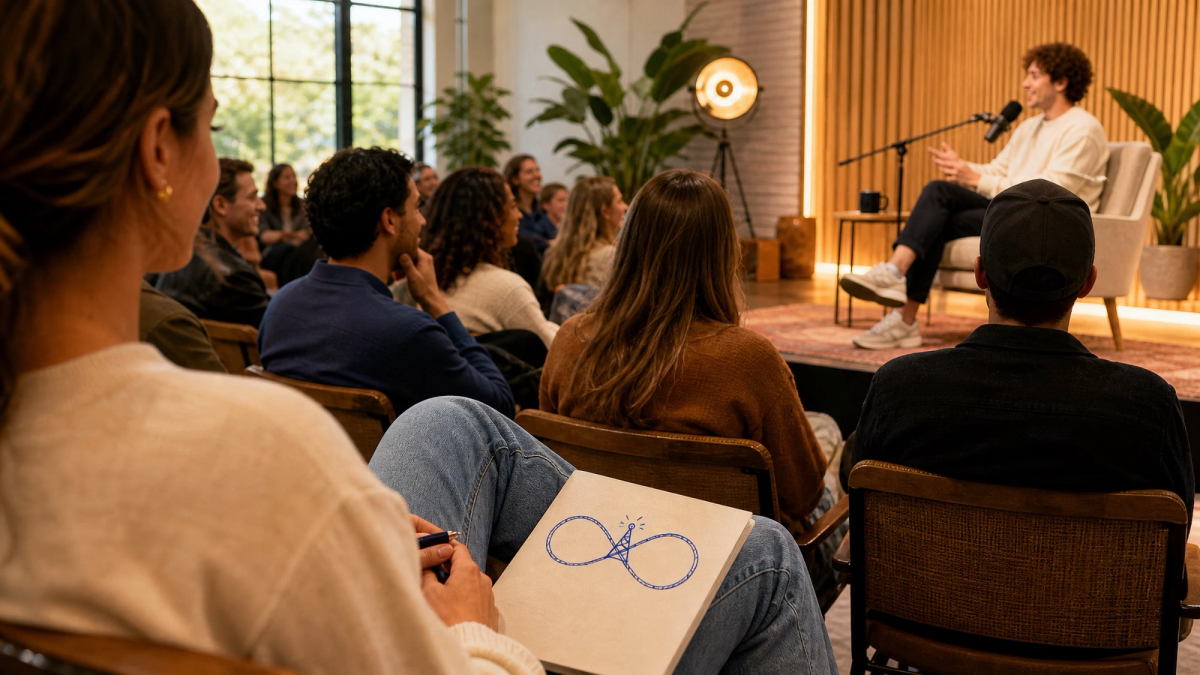
One of the ideas I'm most excited about at Poduty is what I call the infinite seat theater. We stream live podcast recordings so that an audience member in London can watch a live show happening in our physical studio. The live experience still happens. The intimacy still exists. But the reach becomes unbounded.
This isn't just a clever venue concept. It's a model for how digital creators should think about community events, live launches, and audience experiences.
When you host a live webinar, a live Q&A, or a live course session, you're doing the same thing. You're creating an event that has the feel of real presence—the energy of live interaction, the immediacy of real-time questions—while reaching people who are geographically anywhere. That combination of intimacy and scale is one of the most powerful tools a digital product seller has available.
The creators who are cleaning up right now in the digital product space aren't just publishing content. They're creating experiences. Their audience doesn't just consume—they participate. They show up live. They feel a part of something. And people who feel like they're part of something don't just buy once; they stay, upgrade, and refer.
Removing Risk to Encourage Experimentation
Part of what I've tried to do at Poduty—and in my digital marketing work more broadly—is remove the barriers that stop creators from starting. The financial risk model we use at the theater aligns venue revenue with creator success, so nobody has to front a massive upfront cost to try a live experience.
The same principle applies to the way you structure your digital product ecosystem. Lowering the barrier to entry isn't just customer-service niceness—it's conversion strategy. When a potential buyer can try before they fully commit, when the onboarding is frictionless, when the first product is priced to get them into the ecosystem rather than to maximize immediate revenue, the lifetime value of that customer skyrockets.
Digital products on Digistore24 work the same way. Your funnel's job isn't just to close a transaction. It's to begin a relationship that earns the right to a second, third, and fourth transaction.
Five Generations and What It Means for Content Strategy
One thing I've observed working with podcasters across different demographics is that right now, five generations are simultaneously experiencing digital transformation. Baby Boomers, Gen X, Millennials, Gen Z, and Gen Alpha are all online, all consuming content, all looking for information and community—but in radically different ways.
The creators who serve one of those generations with precision—who speak their language, address their specific concerns, and show up where they actually spend time—will always outperform creators trying to serve everyone at once. And when you own your audience infrastructure, you can segment and serve those sub-communities without asking anyone's permission.
Your email list lets you segment. Your podcast feed lets you go deep. Your community space lets you have the kind of conversations that no algorithm-driven feed ever surfaces.
The more owned your infrastructure, the more targeted your communication can be. And the more targeted your communication, the better your conversions.
Authenticity and Playfulness as Business Assets
Here's something I've believed since the skateboarding days: if you're tense, you hold back. And when you hold back, you lose the thing that makes you worth paying attention to.
The ability to feel safe, to laugh, to be genuinely yourself in your content is not a personal luxury. It's a business asset. Audiences can tell the difference between a creator who is performing authenticity and one who is actually being themselves. The latter builds the kind of trust that generates word-of-mouth.
For digital creators, this means the energy you bring to your content—the quirks, the humor, the things you care about that seem tangential—are often the things your best customers remember. They're the signal that you're a real person, not a content machine. And real people build communities. Content machines just generate traffic.
Practical Takeaways for Digital Product Sellers and Creators

- Own your distribution. Email lists, podcast feeds, and owned community spaces are infrastructure. Social media is a traffic source—not a business asset.
- Consider podcasting as a relationship-building engine. Podcast audiences are loyal, high-intent, and convert well on digital offers.
- Design your funnel to begin relationships, not just close transactions. Low-barrier entry points that earn trust lead to higher lifetime value.
- Create live experiences, even if your product is digital. The combination of intimacy and scale is a conversion force multiplier.
- Serve one generation with precision rather than all of them at once. Specificity in audience targeting always outperforms breadth.
- Let your personality be visible. Authenticity and playfulness are trust signals, not distractions.
Control Is the Asset
The creator economy is not going to slow down. But it will keep shifting the rules for creators who build on borrowed ground. Every platform update, every algorithm change, every demonetization event is a reminder that reach without ownership is fragile.
The people winning long-term in this economy are not the ones with the biggest follower counts on a platform they don't control. They're the ones who've built the podcast feed, the email list, the community, the course library—and who treat each platform as a traffic source feeding into something they own.
You have more control available to you right now than creators had at any previous point in the history of media. The question is whether you're using it.
Start building the infrastructure that belongs to you. Your future audience will be grateful—and so will your future revenue.
If you're ready to take more control over how you build and reach your audience, explore what other creators are doing on the Digistore24 Blog. And check out Jeff's work at Stuff I Never Knew and Poduty for a front-row look at the future of creator-owned content.


