


Ten years in SEO teaches you that the strategies working well today rarely work forever. The operators who build businesses that last figure out what's durable before everyone else does.
I spent the better part of a decade building an affiliate portfolio. At its peak, it was 40 sites and $1.4 million in annual recurring revenue. I learned what drives traffic, what converts, and what collapses the moment Google decides to change its mind about your category.
That last lesson is the one worth discussing. Because diversification isn't optional anymore.
Why Relying on a Single Traffic Channel Is a Fatal Mistake
There's a version of affiliate marketing that many people start with: rank a site on Google, collect commissions, repeat. It works, right up until it doesn't. And when it stops working — because of an algorithm update, a core update, a helpful content update, a YMYL reclassification, or any of the dozen other ways Google can reshape traffic overnight — the impact is immediate and severe.
"We can't rely on Google alone anymore — it's suicide."
I've watched good operators lose six-figure monthly revenue in a single day because their entire business was built on one traffic source. Not because their content was bad. Not because their sites weren't well-built. But because concentration risk caught up with them.
For affiliate marketers promoting offers through platforms like Digistore24, this is not a hypothetical risk. It's a structural one. A single-channel strategy — whether that channel is organic search, a single social platform, or a single paid traffic source — creates a fragile business regardless of how well it's currently working.
The question isn't whether to diversify. It's where to build next.
Calculators and Digital Assets: The Next Layer of Defensible Traffic
After scaling my portfolio, I've moved toward what I think of as digital assets — specifically, calculators and interactive tools that live on a site and generate qualified leads through search traffic that's genuinely hard to compete with.
Here's why calculators work differently than standard blog content.
A well-built calculator serves an extremely specific intent. When someone searches for "M&A valuation calculator" or "legal settlement tax calculator," they're not browsing for information. They're looking for a tool that solves a specific problem right now. If your calculator does that well, you earn a top-three ranking, the user gets value, and you have a natural opportunity to capture their contact information in exchange for the result.
That's a qualitatively different conversion event than a blog post. The user arrived with a specific problem. You solved it. The lead capture comes at the moment of maximum relevance.
The Right Way to Build Calculator Assets
My development timeline for a calculator is two to three months — not twenty minutes with a ChatGPT prompt. Three filters matter:
- Keyword validation. I won't build for a keyword with fewer than 1,000 monthly searches. Below that threshold, even a top-three ranking won't justify the build.
- Client-keyword fit. Not every calculable topic is one where a specific business can realistically rank. EBITDA and credit card calculators are dominated by massive financial media sites. Niche calculators — M&A valuations for small businesses, cost segregation for real estate, settlement taxes for personal injury — have realistic competitive landscapes.
- Quality signals. A calculator that ranks requires more than a working widget: clear explanations, legitimate methodology, and enough editorial authority on the surrounding domain to be taken seriously.
Get those three things right and you've built an asset that generates leads for years, not weeks.
The Multi-Channel Lead Generation Engine
The calculator is the first layer. What makes the strategy compound is what happens after the lead is captured.
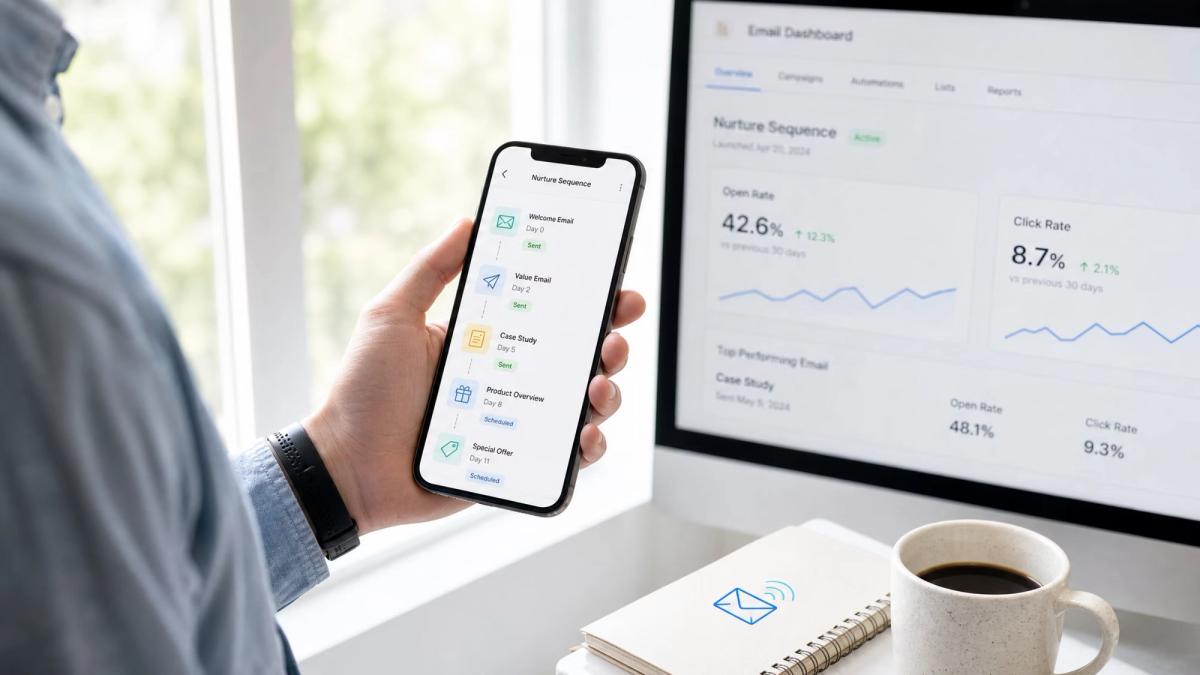
A user arrives via organic search, solves their specific problem with the calculator, and exchanges their email for the full result or a deeper resource. They enter a three-to-five day nurture sequence that contextualizes the result, builds authority, and introduces a relevant offer. After the sequence, a direct offer becomes a natural continuation of a journey the user initiated.
For digital product sellers on Digistore24, the lesson isn't that you need calculators specifically — it's that tools solving a specific problem at the moment of highest intent create a better conversion environment than generic content. A quiz diagnosing a buyer's primary obstacle before presenting your course beats a blog post about your course's benefits. A free tool helping someone estimate what they need to earn creates better context for your pricing course than a cold sales page.
How AI Search Changes the Calculus

I watch my clients' appearances in ChatGPT and Perplexity for high-intent keywords. Quality, authority, and strong SEO still correlates with AI search visibility — not just Google.
The content types AI search struggles to replicate are specific, tool-based, and data-rich. A generic explainer on "how to value a business" is easy for an AI to synthesize. A specific calculator with real inputs is harder to replace, because the specificity is the value.
Middle and bottom-of-funnel content — the stuff closest to a buying decision — is where strategic investment makes the most sense right now. Top-of-funnel informational content is increasingly commoditized. Tools and content that help someone make a specific decision will remain valuable because they require context general AI models don't have.
For affiliate marketers, this suggests a shift toward comparison content, decision tools, and highly specific recommendations over broad educational posts.
The Fractional SEO Mindset: Know What Happens After the Click
I no longer think of myself as a traffic provider. I think of myself as a fractional partner in the client's revenue system. Before any campaign, the questions I ask are: What's your sales process? What happens after a form submission? What does a good lead look like?
Shocking but true: roughly 80% of local business form submissions get zero response. The traffic problem most businesses think they have is actually a follow-up problem. More leads without a response system just amplifies the waste.
For digital product sellers, the parallel is your post-purchase flow. Affiliates who send traffic to a funnel with no retargeting, no email follow-up, and no upsell path leave significant commission potential on the table. Build the back half first, or at least simultaneously. Traffic into a leaking funnel just drains faster.
Practical Takeaways for Affiliate Marketers and Digital Product Sellers
1. Diversify your traffic sources before you have to. If more than 60% of your traffic comes from a single source, you're carrying concentration risk. Start building the second channel while the first is still working.
2. Consider adding an interactive tool to your lead funnel. A quiz, assessment, or simple calculator at the top of your funnel creates higher-intent leads and better conversion context than a static lead magnet alone.
3. Validate keyword volume before building. Any tool or calculator you build as a traffic asset needs a minimum search volume to justify the investment. Don't build without confirming the demand exists.
4. Build multi-step nurture sequences after lead capture. Three to five emails that follow up on the specific thing the user calculated or discovered create far better conversion rates than a generic welcome sequence.
5. Monitor your presence in AI search tools. Run your brand name and top keywords through ChatGPT and Perplexity quarterly. What appears — and what doesn't — tells you where your authority signals are working.
The Asset That Keeps Working
Blog posts are rented. Paid campaigns run until you stop paying. Social content decays within days.
A well-built digital asset — a calculator, a tool, an interactive resource — can rank and convert for years if it's built right. It's one of the few plays left in SEO where the quality of execution creates a moat that's genuinely hard to duplicate.
I spent a decade building affiliate sites. The lesson I carried forward is that the assets worth building are the ones that keep working after the initial effort is done. Calculators are the clearest example I've found. Your version might look different — an assessment, a template generator, a personalized audit tool. But the principle is the same: solve a specific problem so well that the solution earns its ranking.
If you want to build traffic assets that compound alongside your Digistore24 offers, explore how TrioSEO's fractional SEO approach can turn SEO into a revenue system rather than a reporting function.


