


Growing up watching my father work with wood, I absorbed the craft long before I ever thought about calling it a business. The smell of sawdust, the grain of walnut under a planer, the satisfaction of a clean dovetail joint—those weren't strategies. They were just what Sundays felt like.
But somewhere between a childhood in Pennsylvania and running Foxmoor Studio out of a shop thirty feet from my cabin, I learned something that nobody in a marketing course will teach you: specificity is the most powerful thing a creator can put into the market.
And if you sell digital products, courses, or affiliate offers, that lesson applies to you just as much as it does to someone cutting custom woodwork by hand.
The Artisan Trap—and Why Going General Kills You
When you first start out, the instinct is to keep your options open. Offer everything. Serve everyone. Cast the widest possible net.
I made custom furniture. I made décor. I made gifts. I was technically good at all of it. But "good at a lot of things" is almost invisible online.
What changed my trajectory wasn't getting better at the craft—it was getting more specific about what I made and who I made it for. When I started leaning into what was genuinely unique about Foxmoor Studio—sustainably sourced materials, honest construction, a minimalist aesthetic grounded in real country living—the right customers started finding me.
Digital product sellers, course creators, and affiliate marketers run into the exact same problem. A course about "online business" competes with ten thousand other courses about online business. A course about "monetizing a YouTube channel for faith-based educators" is a different conversation entirely. Narrow is not limiting. Narrow is a competitive moat.
Etsy as a Case Study in Marketplace Discovery

I want to be honest about something that surprised me: the platform mattered more than I expected.
When I opened my Etsy shop, I wasn't expecting global reach. I'm a woodworker in Cookeville, Tennessee. But Etsy's search structure rewards niche listings—the algorithm surfaces specific items to buyers who are already looking for something that precise. I've sold to customers in Australia and England. That's not a fluke; that's what happens when the platform and the product are matched correctly.
For digital product sellers, this maps directly onto marketplace and platform selection. Listing your affiliate offer or digital product on Digistore24 works the same way. Buyers on the platform are already in a purchasing mindset. Your job is not to convince them that digital products are valuable—they already believe that. Your job is to be the most specific, most credible version of what they're searching for.
That requires a niche. Every time.
"Find a Niche Item, Something Unique. That's the Key."
"Find a niche item, something unique. That's the key."
I said this during the podcast almost offhandedly, but I believe it completely. It's the condensed version of everything I've learned across years of showing up and selling.
The custom woodworking market is not small. But the segment of that market that wants pieces made with sustainably sourced materials, by a sole proprietor who respects the craft enough not to franchise it, with a minimalist aesthetic that fits cabin living? That segment is specific. And specific segments have less competition, higher perceived value, and customers who are already sold before they ever contact you.
In the digital product world, "niche" isn't just about the topic of your product. It's about the specific transformation you're promising, for the specific person who needs it, delivered in a specific way that fits their life. The closer you can get to that precision, the less work your marketing has to do.
The Sole Proprietor Decision: Intentional Simplicity as a Strategy
People ask me why I've kept Foxmoor Studio as a sole proprietorship. The honest answer is that it's not a limitation—it's a choice.
I don't want my name on furniture I didn't make. I respect the craft too much for that. And I'm not trying to build a corporation; I'm trying to build a business that reflects who I am and operates at a scale I can manage with integrity.
What I've found is that this decision actually builds trust. When a customer buys from Foxmoor Studio, they know they're buying from me. Not from a factory with my logo on it. There's a directness to that relationship that you simply cannot replicate at scale—and buyers are willing to pay for it.
For digital creators, the parallel is real. There's a reason buyers respond more strongly to personal brand courses and creator-led products than to white-labeled, faceless offers. The people selling at the highest conversion rates on platforms like Digistore24 are often the ones whose face, voice, and story are woven into the product itself. Your specificity as a person is part of the product.
Simple Business Models Are Underrated
I am, by my own admission, a minimalist. I prefer the warm comfort of a cabin over a luxury resort. My shop is a short walk from my front door. My business model is, as I described in the podcast, intentionally simple.
When you know exactly what you make, exactly who you make it for, and exactly how you want to deliver it, every decision becomes easier. You don't say yes to the wrong projects. You don't dilute your catalog trying to serve customers who were never the right fit. You don't burn out chasing growth that takes you away from the thing you're actually good at.
Digital product businesses that struggle are often suffering from complexity they added voluntarily. Too many SKUs. Too many traffic channels. Too many affiliate programs for audiences that don't overlap. Simplicity is not a compromise; it's a structural advantage.
The best funnels are simple funnels. The best catalogs are focused catalogs. The best affiliate portfolios are niche portfolios.
Community as a Growth Channel No Algorithm Controls
One of the things I'm most excited about is reconnecting with the local market here in Cookeville. The art scene is genuinely wonderful. There are local markets, events, and communities where handmade goods carry real cultural value.
This matters because it represents a growth channel I own entirely. No algorithm decides who sees my work at a local market. No platform changes its ranking criteria overnight. The relationships I build in those spaces belong to me.
For digital product sellers, the equivalent is your email list, your community, your direct audience. Marketplace platforms are incredible tools for discovery—just like Etsy was for me. But the businesses that scale sustainably are the ones that convert that marketplace discovery into an owned relationship.
Practical Takeaways for Digital Product Sellers
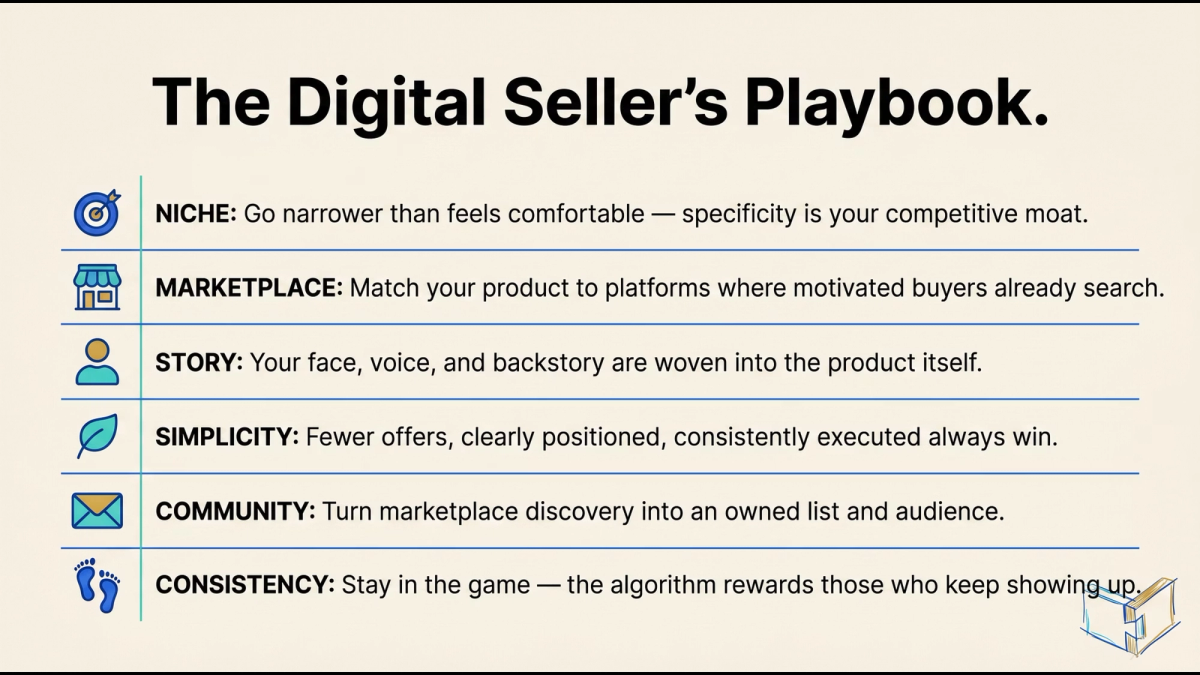
- Niche down further than feels comfortable. The narrower your offer, the less competition and the higher the perceived value.
- Match your product to the right marketplace. Platforms already have motivated buyers—your job is to be specific enough to be findable.
- Your personal story is part of the product. Buyers respond to authenticity and direct relationships with creators.
- Simplicity is a system, not a limitation. Fewer offers, clearly positioned, consistently executed beat sprawling catalogs every time.
- Turn platform discovery into owned audience. Marketplace traffic should feed your list and community, not replace them.
- Keep one foot in front of the other. Even when it's slow, consistency wins. The algorithm rewards those who stay in the game.
The Long Game Is Still the Right Game
I didn't launch Foxmoor Studio at full speed. I started in Pennsylvania, built a client base, moved to Tennessee, and rebuilt locally while Etsy expanded my reach. Some periods were slow. Some pivots were frustrating. But I never stopped.
"Even when it's slow, just keep one foot in front of the other, and it always picks up."
That's not motivational filler. That's the actual operating principle behind every sustainable creator business I've ever seen up close.
Whether you're selling handmade woodwork or a digital course on affiliate marketing strategy, the mechanics are the same: be specific, be consistent, be authentic, and let the right customers find you. The platform can amplify your signal—but only if you have one.
If you're building a digital product business and you're struggling to stand out on crowded marketplaces, the answer almost never involves doing more. It involves doing something more specific. Start there. Explore more creator insights like Jon's on Digistore24's blog and discover how other entrepreneurs are turning passion and niche positioning into profitable digital product businesses.


