

Marcus Cole quit his job at a digital ad agency to launch The Faceless Channel Playbook, a course that teaches creators how to build YouTube channels without appearing on camera.
The course was good.
His first year of selling it was not.
He'd built the course on nights and weekends for eight months before launch, confident the content itself would carry the business.
It didn't.
But the content was never the problem. The commerce underneath it was.
We sat down with him after his first full year on Digistore24 to talk through the mistakes, the fixes, and the numbers behind them both.
1. A "Guarantee" Without Compliance Backing Is a Liability—Not a Selling Point
Marcus originally launched his course with a 30-day money-back guarantee because every course he'd ever bought had one.
What he hadn't accounted for was how his original payment processor handled the resulting disputes.
"Refund requests quickly turned into chargebacks because I didn't have a clean process for handling them," said Marcus. "Each one hit my processing account like a fresh blow."
At one point, a single bad week of disputes was enough to trigger a manual review on his original account—the kind of review that freezes payouts. And he didn’t even find out until his next payout didn't arrive.
On Digistore24, refunds and chargeback disputes are managed as part of the platform's merchant of record (MoR) service, with a dedicated process for customer communication. After switching, Marcus’s dispute rate dropped by more than half in his first two quarters. And the payouts are something he’s never had to worry about since.
2. International Sales Are Only Revenue If the Payment Actually Clears
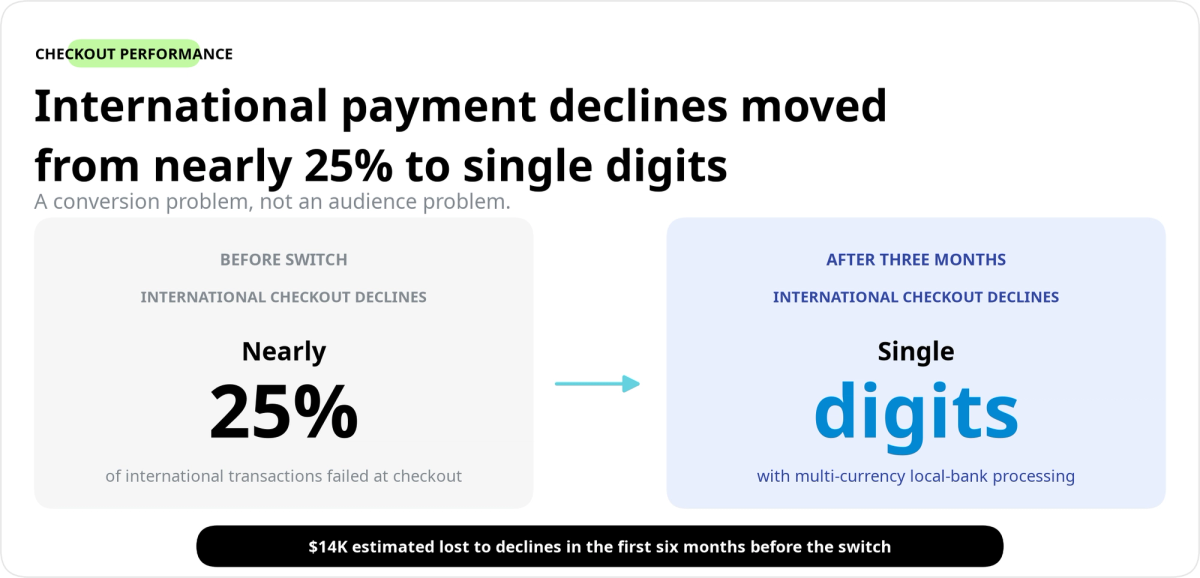
The Faceless Channel Playbook found an audience well beyond the US almost immediately, largely through organic YouTube search.
But there was a problem: nearly a quarter of his international transactions were failing at checkout.
"I was getting the traffic, but I wasn't getting the revenue," said Marcus. "I didn't even know decline rate was a metric I should be tracking until I saw it broken out for the first time."
He estimates he lost close to $14,000 in his first six months to declines alone—sales where a buyer clicked “purchase" but never actually completed the transaction for reasons that had nothing to do with whether they wanted the course or not.
After switching to Digistore24, he had access to multi-currency processing through local banks—which brought his international decline rate down to single digits within three months.
3. Recurring Revenue Needs Recovery Systems, Not a Subscribe Button
Marcus's premium membership tier—ongoing YouTube automation templates and monthly coaching calls—is a recurring product. And recurring products live and die on renewal rates. But Marcus didn't understand that until he started accidentally losing subscribers.
For months, he assumed every canceled subscription meant a member had decided to leave. When he finally dug into the data, most of his "cancellations" weren't decisions at all. They were expired cards, banks flagging a routine charge, or a payment that simply failed to process—quiet failures that looked identical to a subscriber walking away, but in fact had nothing to do with that at all.
"I was treating every failed payment like a lost customer,” said Marcus. "Most of them weren't gone. Their card just didn't work that month, and nobody told them—and then nobody tried again."
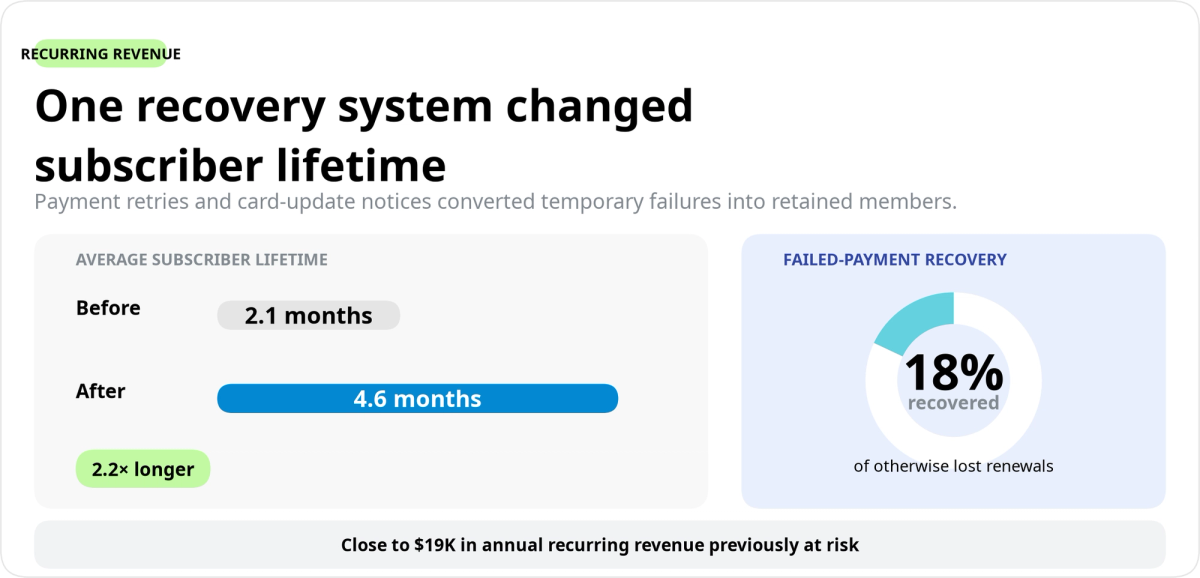
Digistore24 automatically retries a failed renewal payment several times before a subscription is canceled, and then also notifies the subscriber so they can update their card. That single change recovered close to 18% of what would have otherwise been lost renewals in Marcus's first six months on the platform—subscribers who wanted to stay, but simply needed one more attempt at getting charged. This one fix alone changed his stats dramatically:
- Failed payment recovery rate: 18%
- Average subscriber lifetime before: 2.1 months
- Average subscriber lifetime after: 4.6 months
That gap between 2.1 and 4.6 months is close to $19,000 in annual recurring revenue Marcus was losing to nothing more than expired cards—and he didn’t even know it was happening.
4. Affiliates Don't Show Up Because You Ask. They Show Up Because the Data Is Good
Before Digistore24, Marcus recruited affiliates one direct message at a time.
It worked, slowly, and mostly with people who already knew him. He estimates he spent close to five hours a week on outreach, most of which went nowhere. And the affiliates who did say yes were usually friends doing him a favor, not people evaluating the offer on its own merits.
"I was asking people to trust me instead of showing them numbers," Marcus said. "That only gets you so far, and it definitely doesn't scale past your existing network."
Listing on the Digistore24 Marketplace changed the math.
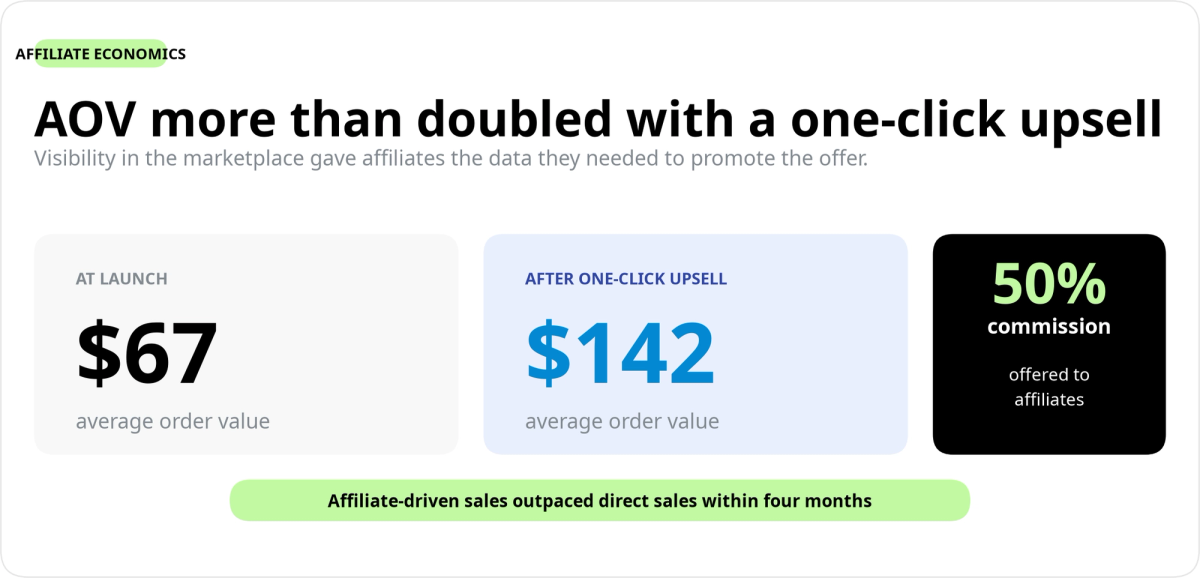
Affiliates could see his commission structure, his AOV, and his conversion rate before ever reaching out to him, which meant the first conversation was never a cold pitch—it was someone who had already decided the offer looked worth promoting. One affiliate he'd never spoken to, a creator with a mid-size channel in the online business niche, found the offer through the marketplace and became his single largest traffic source within two months, without a single direct message from Marcus.
- Commission offered to affiliates: 50%
- AOV at launch: $67
- AOV after adding a one-click upsell for 1-on-1 channel audits: $142
5. The Back Office Is Where Most Course Creators Burn Out
Marcus didn't leave his agency job to spend his evenings reconciling invoices and manually calculating affiliate payouts.
But that's what the first year looked like—Sunday nights spent cross-checking spreadsheets against bank deposits, trying to figure out which affiliate was owed what, and occasionally getting it wrong.
"I once underpaid an affiliate by almost $400 because I mismatched a spreadsheet formula," he said. "She was really nice about it, but that's not a mistake you want to make twice with someone sending you real traffic."
After switching to Digistore24, automated invoicing, tax handling, and affiliate payouts freed up roughly ten hours a week of this time—time he now spends producing course content instead of chasing spreadsheets.
He also stopped worrying about international tax obligations—which he didn’t even fully understand in the first place.
Now, rather than having to do the research himself between filming sessions, he can just relax, because compliance is handled automatically as part of the Digistore24 platform.
"The back office was never something I planned to be good at," he said. "I just needed it off my plate—I did not want that to be my job."
The Result
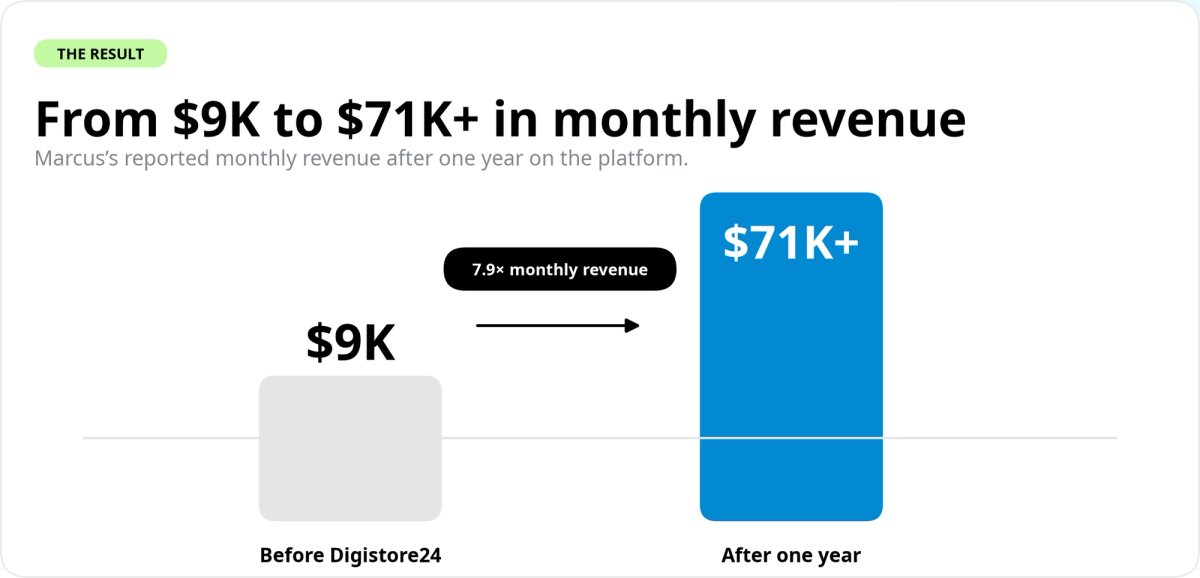
Marcus's monthly revenue grew from about $9,000 to just over $71,000 in his first year with Digistore24, split roughly evenly between direct sales, affiliate-driven sales, and membership renewals.
The membership tier alone now retains subscribers more than twice as long as it did in his first six months—almost entirely because of the automatic payment retries.
None of that growth came from a single relaunch or a viral video. It came from five separate leaks getting closed one at a time. Leaks that had each been quietly capping his revenue without showing up anywhere he was looking.
The disputes were hiding in his processor dashboard. The declined international payments were hiding in traffic analytics that never separated visits from completed sales. The lost renewals just looked like the normal cost of running a subscription business. The affiliate ceiling looked like a networking problem instead of a discovery problem. And the back office looked like the normal cost of doing business—right up until it wasn't.
"None of this was just one big win," he said. "It was five smaller problems that were each discreetly capping my growth, and I only really noticed once they were gone. If you'd asked me at the start which one mattered most, I'd have guessed wrong on at least three of them.”
What would you tell someone about to launch their first course?
"Budget time for the business side, not just the content. I spent eight months on the course and zero hours thinking about checkout or refunds. That ratio should've been balanced—if not reversed entirely.”
What's the first thing you'd fix if you were starting over?
"The guarantee and refund process, for sure. That was the main thing damaging my account before I even knew it was a problem."
Did switching platforms slow down your launch momentum?
“No, not at all. That's what I was expecting to happen, but it didn't. The migration was super simple, took about a week total, and I didn't lose any active subscribers in the process."
What's one number you check every week now that you never used to?
"Decline rate. It sounds boring, but it's real money. Lesson learned.”
Want to Stop Losing Sales to a Broken Checkout?
Are you suffering some of the same issues as Marcus? Then it's time to switch to a platform built to handle disputes, international payments, recurring billing, and affiliate recruiting in one system—instead of five separate problems you have to catch on your own.
FAQ
Is Digistore24 only for physical products?
No. Digital courses, membership programs, and coaching offers run on the same checkout, subscription, and affiliate infrastructure as physical goods.
How does the platform help with international course sales?
Digistore24 processes payments through local banks in multiple currencies, which improves acceptance rates for buyers outside the seller's home market.
What happens to my affiliate program if I switch platforms?
The Digistore24 marketplace gives affiliates visibility into your offer's commission rate and performance data directly, so you're not solely dependent on affiliates you've personally recruited.