

Roughly 80% of brands now run some form of affiliate program. In fact, by 2027, the affiliate market is expected to reach about $48 billion globally.
That’s a huge opportunity. It’s also a problem if you’re just getting started.
You’re stepping into a market where big players already have their strategies dialed in. They’ve tested thousands of content types, funnels, and offers. They know what converts, and they move fast. If you’re new, it can feel like you’re showing up late to a game that’s already been figured out.
Then there’s the platform problem.
Not all affiliate networks are built the same. Some pay less than you expect or delay payouts when you’re just starting.
Others don’t have offers that fit your niche. And many hide the details that actually matter — like payout speed, refund windows, or the challenge of getting approved. Those factors determine whether you grow or get stuck.
So we did the boring research for you.
This list breaks down the best affiliate networks for beginners in 2026. These are platforms with a low barrier to entry and payout structures that let you scale quickly, even with a small budget (without getting stuck in the early stages).
Let’s look at each one so you can decide which fits your affiliate strategy.
Brief Overview: 9 Best Affiliate Networks for Beginners
Quick Start Guide for New Affiliate Marketers
If you’re new to affiliate marketing, don’t overthink it. You don’t need a fully fleshed out brand or a complex funnel to get started. You just need a clear focus, the right platform, and a system you can actually use.
Choose a Niche
Start with a topic. What space do you plan to create content and promote products in? What do you actually understand or care about? That could be fitness, tech, finance, gardening, or any category you’re willing to research deeply.
This matters more than people think. Affiliate marketing runs on trust. When your content shows in-depth knowledge, people are more likely to click and buy. And it needs to make sense — don’t try to sell running shoes on a gardening channel. Stick to products that fit your audience niche.
Pick a Content Platform
You don’t need a website on day one (for some platforms). Many beginners start on YouTube, TikTok, or Instagram because they already have built-in distribution.
These platforms reward consistency, not perfection, so the key is to pick one and commit. Affiliate marketing works best when you learn which content drives clicks. That typically only happens with repetition and testing.
Choose the Right Affiliate Network
This is where most beginners go wrong.
There are a lot of affiliate networks out there, and not all of them are built to help you succeed. Some pay late. Some take a larger cut than they should. Others just don’t have offers that convert.
A few are starting to fix that, but you still need to choose carefully. Before you promote anything, check the basics:
- Payout method + threshold: With too large of a threshold, reinvesting payouts to scale your strategy can be difficult.
- Cookie duration: 30–90 days is standard; longer windows give you more chances to earn
- Commission structure: Most fall in the 5–30% range, but digital offers can go higher
- Payment reliability: If payouts are delayed or unclear, that’s a red flag
Create Useful Content
As an affiliate, your job is simple: help people make decisions. That usually means creating honest reviews, simple tutorials, direct comparisons, and similar helpful content.
When it solves a real problem, content works. If it feels useful, people engage. If it feels forced or off-topic, they don’t.
Disclose Your Links
In the U.S., the Federal Trade Commission requires clear disclosure when you earn from affiliate links.
Keep it simple. A line like “I earn commission from this link” is enough (as long as it’s easy to see within your content). That transparency also builds trust with your visitors, which drives long-term results.
Digistore24
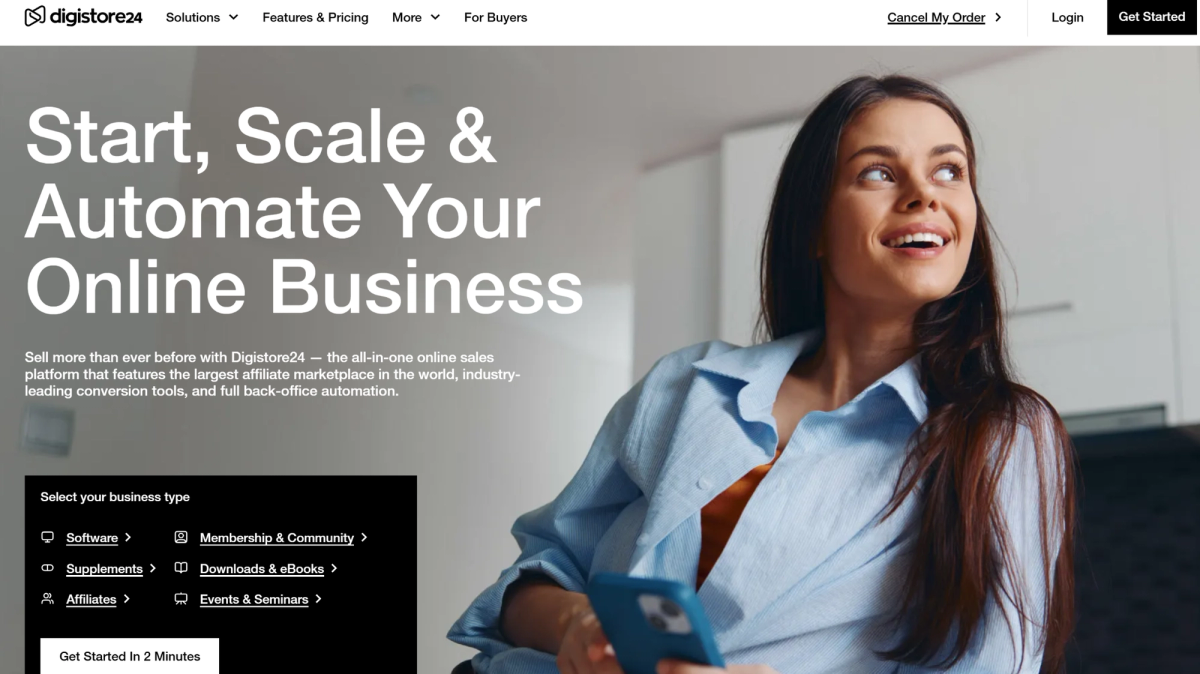
Digistore24 launched in 2012 in Hildesheim, Germany to help entrepreneurs sell digital products worldwide without needing to deal with taxes, refunds, or compliance. Digistore24 acts as the merchant of record, meaning we legally handle the transaction and tax compliance for every sale so vendors and affiliates can focus on growth.
Today, Digistore24 is one of Europe’s largest affiliate marketplaces, with over 8,500 vetted offers and thousands of active affiliates. While the platform spans 44+ niches, it leans heavily into digital products like courses, ebooks, and memberships, along with a strong presence in health and supplements.
For beginners, it’s one of the easiest platforms to start with. There’s no upfront cost, affiliates are auto-approved, and white-glove onboarding gives you just about everything you need to start promoting quickly. Payouts run up to four times per month, so you’re not stuck waiting to reinvest and can scale quickly by taking advantage of early momentum.
Digistore24 also includes built-in conversion tools that most networks don’t offer. You can create custom checkout interfaces, add one-click or multi-step upsells, run cross-promotions, and split test what’s actually working — all inside one platform.
For sales tracking, Digistore24 uses a standard 180-day cookie window (one of the longest in the industry) with server-to-server (S2S) tracking by default. That means more reliable attribution, even in scenarios where browsers or laws restrict cookie usage.
For beginners, this setup removes a lot of the friction that slows people down early and makes it easier to actually build momentum.
- Ease of entry: Very easy (auto-approved)
- Commission rates: ~15–90% (some trials up to 100%)
- Cookie window: 180 days + S2S tracking
- Refund window: 14–180 days (vendor set)
- Payout speed: Weekly (up to 4× per month)
- Minimum threshold: $50 first payout, $200 subsequent
ClickBank
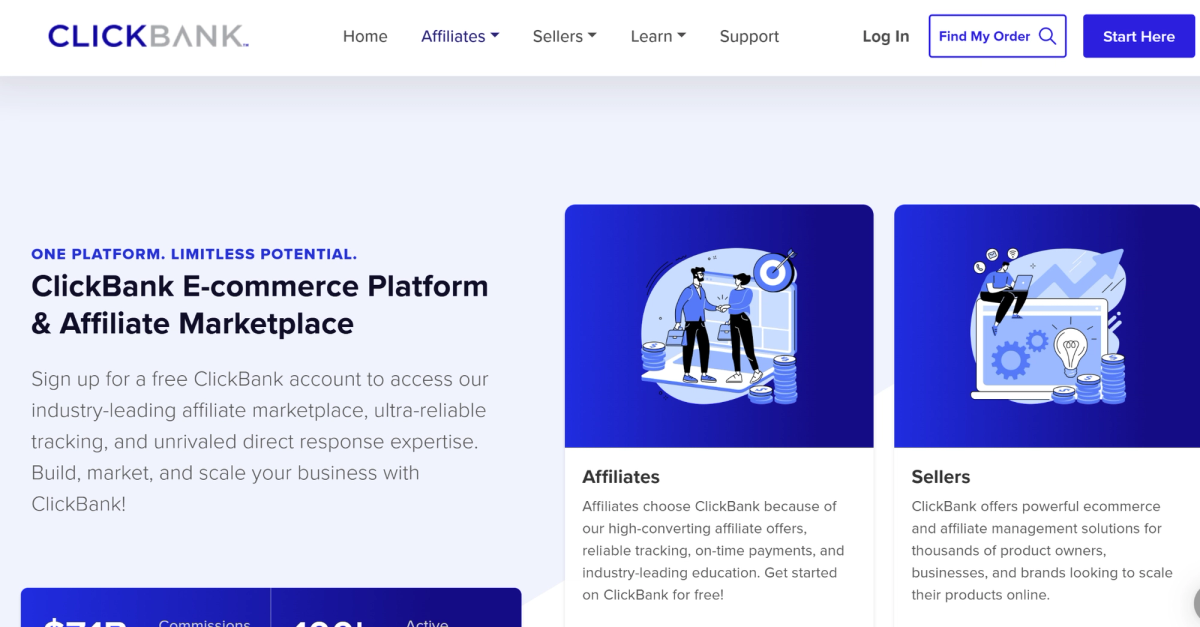
ClickBank was founded in 1998, making it one of the oldest affiliate marketplaces still active today. It was built early around digital commerce, long before most modern affiliate platforms existed.
Today, ClickBank remains a major player in the space, hosting over 100k active affiliates. It connects product creators with affiliates worldwide and acts as the merchant of record, handling payments, billing, and refunds so users don’t need their own infrastructure.
The platform focuses heavily on digital products like courses, ebooks, and software, with strong categories in health and self-help products as well. It also includes some physical offers (mainly supplements tied to direct-response marketing).
For beginners, ClickBank is very easy to enter. You can sign up and start promoting offers right away without approval. The main tradeoff is with product quality, which varies widely. Beginners need to be careful about what they promote if they want to build trust and earn consistently.
Many ClickBank offers pay 50–75% or more, and the platform’s “Gravity Score” helps highlight products that are already converting well. Its Merchant of Record model also removes friction by handling payments and refunds for you, however, some cite that it doesn't have the same robust setup in Europe as other platforms.
Tracking is mostly cookie-based (with a ~60 day window), relying on standard affiliate link attribution. It works well for most use cases. However, in 2024, Clickbank also began offering server-to-server tracking as an option set by the vendor.
- Ease of entry: Very easy (no approval needed)
- Commission rates: ~50–75%+ (vendor set)
- Cookie window: ~60 days + (optional) S2S tracking
- Refund window: ~60 days (up to 364 in some cases)
- Payout speed: Weekly or bi-weekly (with reserves)
- Minimum threshold: ~$10
Amazon Associates
Amazon launched its Associates program in 1996, making it one of the earliest affiliate programs ever created. Today, it’s one of the largest affiliate programs in the world, giving affiliates access to millions of products across nearly every category.
It was designed to let website owners earn commissions by linking directly to products in Amazon’s store. So, there’s no real niche here, and that’s the point. You can promote anything from electronics to books to home goods. This makes it a flexible starting point for beginners still figuring out their direction.
Getting started is also easy. You can apply quickly and begin promoting products right away. The catch is staying in. You need at least three qualifying sales within 180 days to keep your account active. And that’s no small challenge, considering that scaling income is harder due to low commission rates and a very short cookie window.
Tracking is simple and cookie-based, with a standard 24-hour window (one of the shortest in the industry). However, if someone adds a product to their cart during that time, the attribution can extend.
Ultimately, Amazon’s biggest strength is conversion. People already trust the platform, so they’re more likely to buy. You also earn commission on the entire cart, not just the product you linked. But commissions are fixed by category, there are no recurring payouts, and the rules are strict.
- Ease of entry: Easy (must stay active)
- Commission rates: ~1–20% (most ~3–4%)
- Cookie window: 24 hours (extended via cart)
- Refund window: Standard 30 days from delivery; Returns cancel commissions
- Payout speed: Monthly (Net-60)
- Minimum threshold: $10 (deposit/gift card), $100 (check)
Fiverr Affiliates
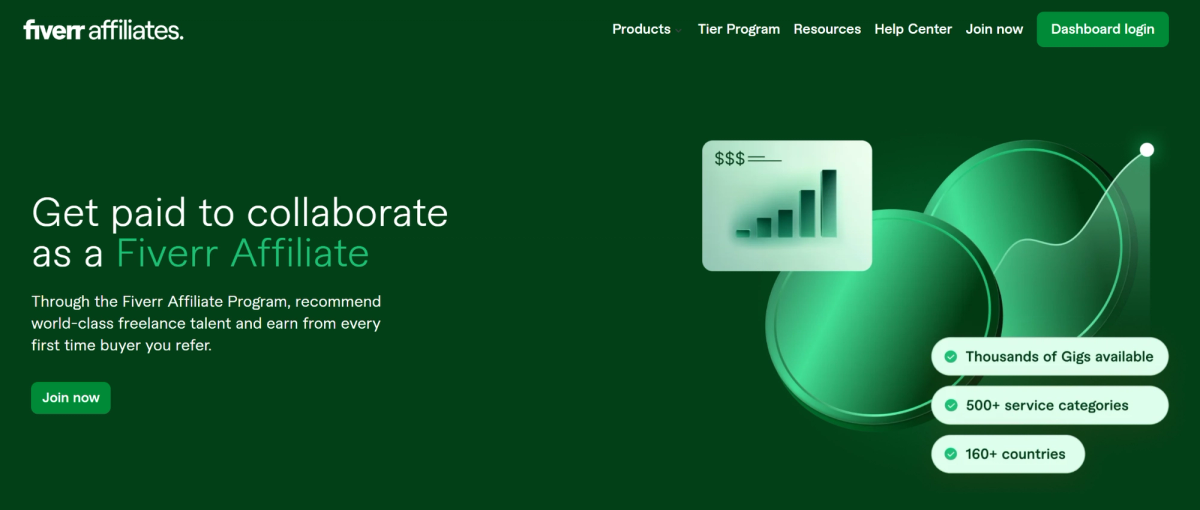
Fiverr launched in 2010 and later rolled out its affiliate program as the platform scaled worldwide. Today, it operates in over 160 countries and brings in millions of buyers each year.
With around 3.6 million annual buyers, Fiverr gives you built-in demand, especially if your audience needs quick, affordable services like design, writing, or marketing.
But keep in mind that with Fiverr Affiliates, you’re not promoting a niche product or tool, you’re plugging into an active service-based marketplace with everything from logo design to full business builds. The main offerings center around the core marketplace, Fiverr Pro for higher-end services, and tools like the Logo Maker.
For beginners, this simplicity helps. You’re promoting one brand instead of sorting through hundreds of offers, and you can use almost any channel (YouTube, social, email, or a simple blog). You don’t need a full site to get started.
Where it gets more complex is the commission model. Fiverr moved away from flat payouts and now uses a hybrid structure based on which service you promote:
- Marketplace Gigs: 25% of first order + 10% rev share for 12 months
- Fiverr Pro: 70% of first order + 10% rev share for 12 months
- Logo Maker: $30 first order + 10% rev share for 12 months
These include upfront commissions plus ongoing revenue share. That can add up over time, but it also makes earnings less predictable while you’re learning.
- Ease of entry: Easy
- Commission rates: Hybrid (CPA + rev share)
- Cookie window: 30 days
- Refund window: ~14 days
- Payout speed: Monthly (Net-30)
- Minimum threshold: $100
Impact
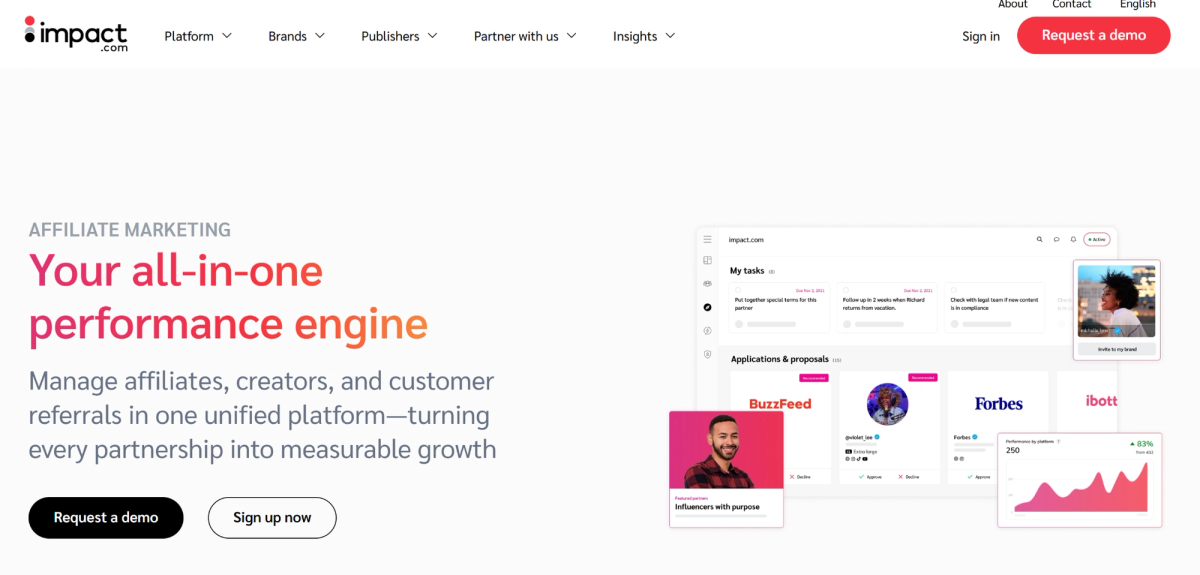
Impact was founded in 2008 in Santa Barbara, California, with a goal of modernizing affiliate marketing for large global brands. From the start, it focused on building partnership infrastructure and has since expanded into several types of partnerships including influencers and media outlets.
Today, Impact is a well-known partnership automation platform used by major companies worldwide. In 2025, it supported nearly 350,000 active partnerships.
While not tied to a specific niche, it leans toward enterprise brands in ecommerce, SaaS, finance, and travel. Most are established companies, so if you get approved, conversions can be easier due to existing brand trust.
For beginners, Impact is a mixed experience. Getting started is straightforward, but gaining traction takes effort. You typically need approval at two levels:
- First to join the platform
- Then again for each brand
However, Impact does offer a shortcut. New users get access to a list of pre-qualified programs inside the dashboard upon signup, which helps you start promoting faster (though the selection is more limited). This is enhanced by Impact’s partner matching system (Impact AI), which uses artificial intelligence to recommend new partnerships based on your profile, which can help surface relevant opportunities early on.
Sales tracking is also strong and reliable. The platform uses both cookie-based and server-to-server tracking, helping ensure more accurate attribution across devices and channels.
- Ease of entry: Moderate (2-level approval)
- Commission rates: ~5–20% (brand set)
- Cookie window: ~30 days (varies)
- Refund window: Brand set
- Payout speed: Brand-dependent (can vary)
- Minimum threshold: $10
eBay Partner Network (EPN)
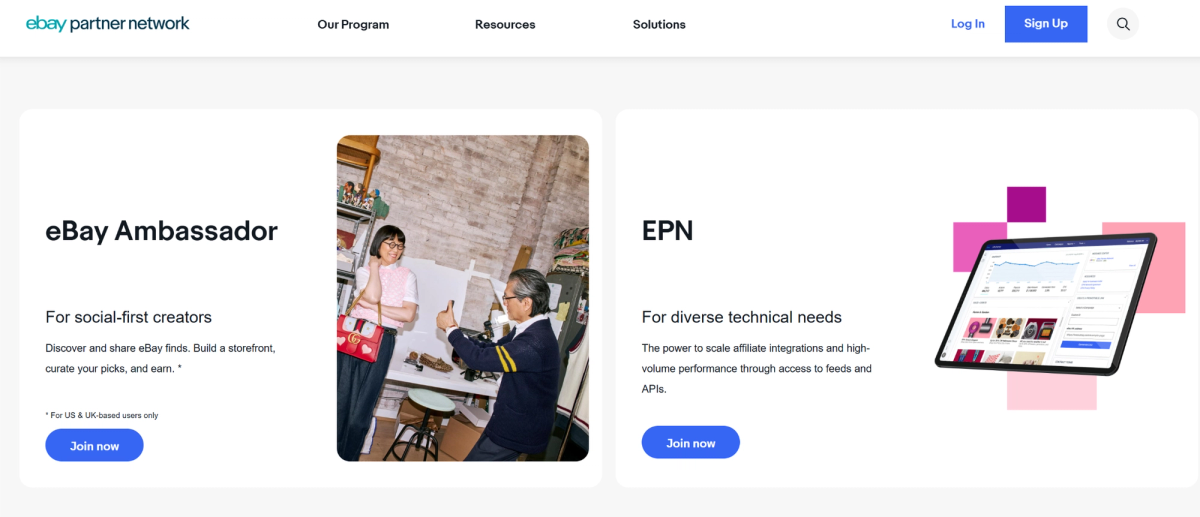
For years, eBay ran its affiliate program through Commission Junction (now CJ Affiliate). Then in 2008, it moved in-house and launched the eBay Partner Network (EPN). Today, it gives affiliates access to one of the largest online marketplaces in the world.
The product range is broad (similar to Amazon) but with one key difference. eBay is strong in collectibles, refurbished items, and niche categories where inventory changes constantly. With over a billion listings, it’s especially useful for deal sites, niche bloggers, and comparison content.
For beginners, entry is moderately difficult. You can apply easily, but you’ll need a legitimate content channel and must follow strict policies. It’s not as open as some platforms, but it’s still accessible if you’re serious.
EPN stands out for its marketplace structure. You can link directly to individual listings, including auctions, and earn commission on the full purchase (not just one item). Tools like Smart Links also help by automatically converting regular eBay links into affiliate links, so you don’t have to build each one manually.
Tracking is cookie-based and tied to eBay’s system. Like Amazon, the standard window is 24 hours, but with a twist. If a user places a bid within that window and later wins the auction (within 10 days), you still earn commission. That helps for auction content, but overall, the window is still short.
- Ease of entry: Moderate (requires content + approval)
- Commission rates: Category-based (share of eBay revenue)
- Cookie window: 24 hours (extended via bid/cart)
- Refund window: ~30–60 days
- Payout speed: Monthly (Net-30 to Net-60)
- Minimum threshold: $10
Awin
Awin was formed in 2017 after merging Affiliate Window and Zanox (two early players in affiliate marketing). Today, Awin connects over a million publishers with thousands of advertisers across retail, travel, telecom, and finance. It works as a facilitator (not a merchant of record), meaning brands run their own programs, while Awin handles tracking, reporting, and payments.
The network is broad but leans mainly into ecommerce and consumer services from established brands. If you want to promote physical products from well-known brands, Awin gives you that access. However, that also means fewer high-margin offers.
For beginners, Awin sits in the middle. You can join, but there is a platform-level approval process. Then, you’ll need to apply again for each advertiser. That may slow things down if you’re trying to test offers quickly or leverage early-stage revenue.
Still, Awin’s strength is its scale and structure. You get access to many brands in one place, along with consolidated payments and tools to find programs that fit your niche. It also uses “bounceless” tracking, which removes redirect links from the typical checkout flow and can improve reliability and SEO.
Awin combines cookies with server-side tracking (when properly set up). If something breaks, Awin’s Conversion Protection Initiative (CPI) tries to recover missed conversions using modeled data as a fallback.
- Ease of entry: Moderate (approval + advertiser applications)
- Commission rates: Varies by brand; typically 15-90%
- Cookie window: ~30 days (varies)
- Refund window: ~30–67 days
- Payout speed: Twice monthly (approval dependent)
- Minimum threshold: ~$20
FlexOffers
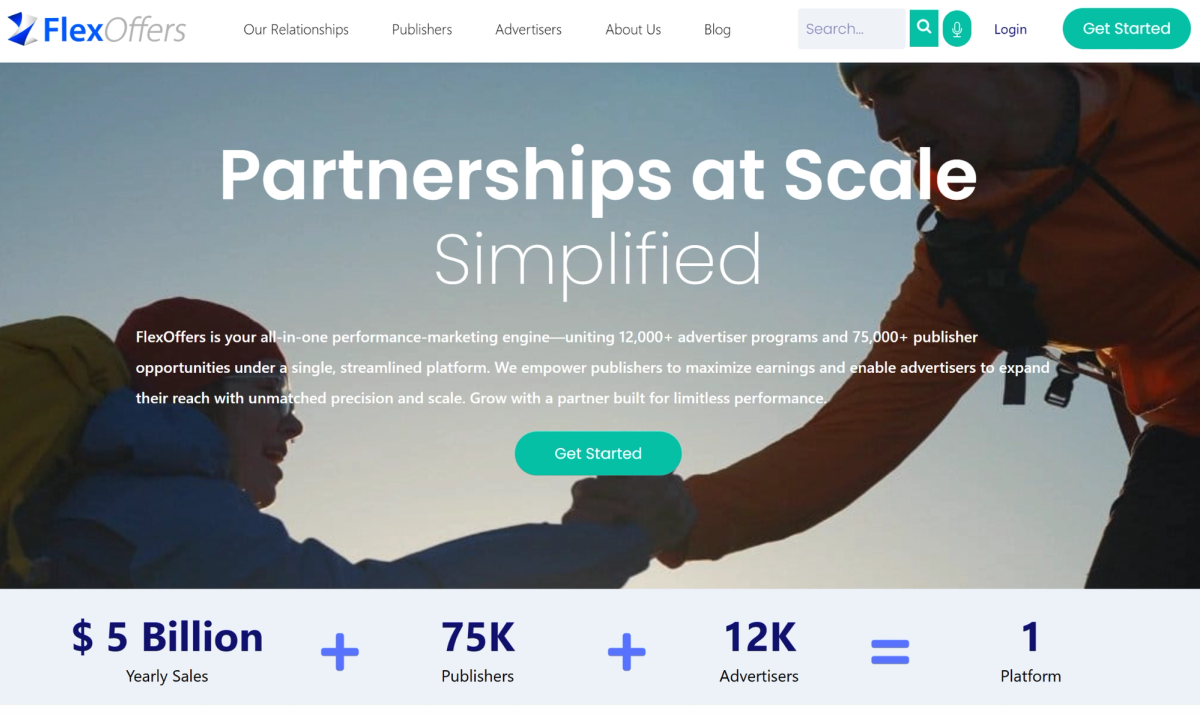
FlexOffers launched in 2008 as a mid-tier alternative to larger networks like CJ and Awin. It has positioned itself as a simpler way for publishers to access a wide range of affiliate programs without managing multiple platforms.
Today, FlexOffers connects over 75,000 publishers with around 12,000 advertisers across many industries. It works as a traditional network but also as an aggregator, pulling in offers from other networks like CJ, Impact, and Awin through API integrations.
That structure gives it a broad product mix. You’ll find retail, finance, travel, subscriptions, and digital services all in one place, which makes FlexOffers useful if you want variety without juggling multiple accounts.
For beginners, entry is fairly easy. You can sign up quickly, but you still need approval from individual advertisers to promote their offers. That adds some friction, especially if you’re trying to test multiple programs.
FlexOffers stands out for its content tools. Features like FlexLinks help automate affiliate link creation, while comparison widgets and coupon feeds make it easier to build review or deal-focused content. These tools are especially useful if you’re producing content at scale.
Tracking is standard for a network of this type. It comb
ines cookie-based tracking with server-to-server integrations, depending on the advertiser setup. It’s reliable and not much different from other major networks.
- Ease of entry: Moderate (fast signup, advertiser approval needed)
- Commission rates: ~2–50% (varies)
- Cookie window: ~30 days (varies)
- Refund window: Advertiser-defined
- Payout speed: Net-30 to Net-60
- Minimum threshold: ~$50
Rakuten Advertising
Rakuten Advertising’s roots go all the way back to LinkShare, one of the earliest affiliate networks founded in 1996. It was later acquired by Rakuten in 2005 and rebranded in 2020 as part of a broader push into global performance marketing.
Today, Rakuten Advertising is a well-established network that connects publishers with major consumer brands. It’s widely used by large retailers and global companies, making it a strong option if you want access to recognizable names (especially physical products). You’ll find programs in retail, travel, electronics, and services, but far fewer digital or SaaS-focused offers compared to newer marketplaces.
For beginners, Rakuten Advertising sits in the middle of the difficulty scale. You’ll need to get approved by the network, then apply again to individual advertiser programs, which can vary in their approval standards.
Rakuten’s strength is its brand relationships. It also connects into loyalty and cashback ecosystems, which can drive higher conversion rates. On the flip side, some users report slow dashboards and delayed reporting, which can make it harder to adjust strategy in real time.
Tracking is solid and built for scale. It combines cookie-based tracking with server-to-server integrations and supports cross-device attribution, which is important for large retail campaigns.
- Ease of entry: Moderate (network + advertiser approval)
- Commission rates: ~2–20% (retail-focused)
- Cookie window: ~30 days (varies)
- Refund window: Advertiser validation periods
- Payout speed: Monthly (Net-60)
- Minimum threshold: Varies by region
Final Thoughts
If you’re just getting started in affiliate marketing, the network you choose matters more than anything else.
Some platforms are built for scale, but not necessarily for beginners. They slow you down with approvals, low payouts, or unclear tracking. Others give you access, but not the tools or support you need to actually grow.
What you want is simple: a network that lets you start fast, test ideas, and get paid quickly so you can reinvest and improve.
Digistore24 fits that model.
It’s built the way affiliate marketing should work (especially for beginners). Many offers come with high commissions (some up to 100% on trial offers), and with fast, reliable payouts and strong tracking, you can build momentum early.
There’s no cost to get started, and signup takes just a few minutes. You don’t need approvals or a full setup. You can start testing, learning, and improving right away.
If you’re serious about building something that works, start with a platform that actually supports beginners.