

By the time Priya Shekar sat down to build The Signal Method, she'd already spent eleven years inside two Fortune 500 companies proving the material worked—not as a course, but as the framework used to coach high-level executives through goal-setting and decision-making under pressure.
In fact, the completion data from those internal workshops was the reason she felt confident turning it into a product at all.
What she didn't have was patience for how her own niche talked about itself.
"Every course in this space sounds the same," she said. "Big promises, no numbers behind them. I built something with actual outcomes, and I didn't want to sell it like a slogan."
But that decision made launching harder than she expected.
The Wall
Her early sales pages, written in plain, evidence-based language, converted at half the rate of her competitors who were leaning on urgency and transformation-led messaging.
She watched offers with vague, sweeping claims consistently outperform hers in the same paid ad space, targeting the same audience at a fraction of the production quality.
Payment processors also flagged her offer twice in her first four months, treating the course's goal-setting claims with the same scrutiny reserved for health products—a common problem in a category that regularly overlaps with wellness and mindset claims. And each review put her checkout on hold for several days at a time, with no clear timeline for resolution.
"I was penalized for being direct,” she said. "Meanwhile, the vague wishy-washy offers around me were converting because they promised everything—and proved nothing. I nearly gave up and rewrote my entire sales page to sound more like theirs. But I'm glad I stuck to my guns."
The Shift
Priya's break came from switching how she treated her own data, not from softening her copy.
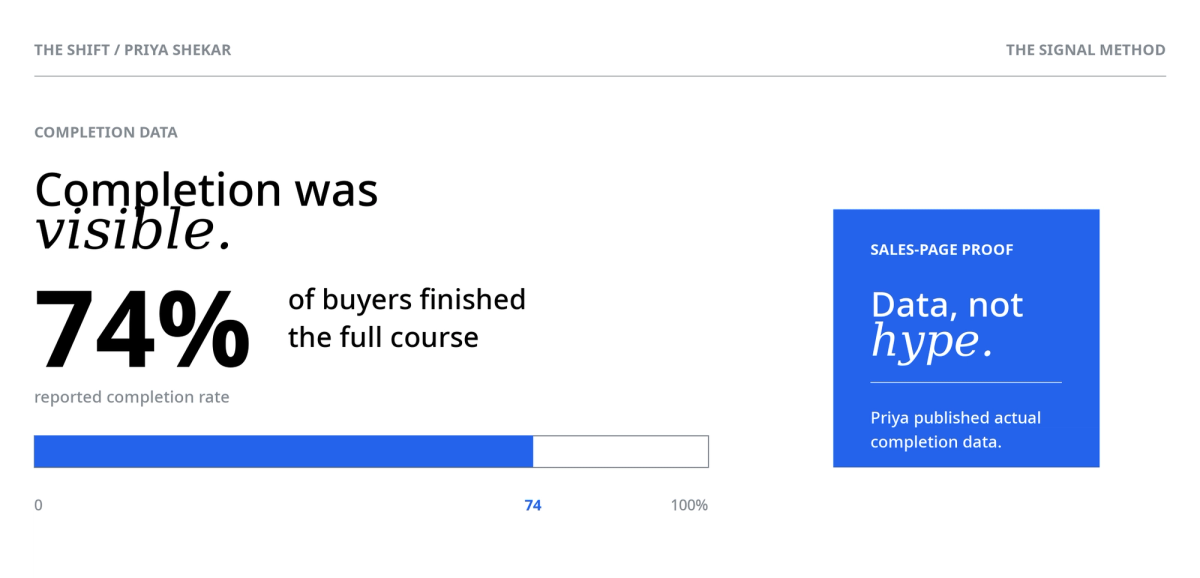
She started publishing her actual completion rates—74% of buyers finished the full course, well above the single-digit completion rates typical of the category—directly on her sales page. And added the results from a short follow-up survey she ran herself, breaking down where buyers were three months after finishing.
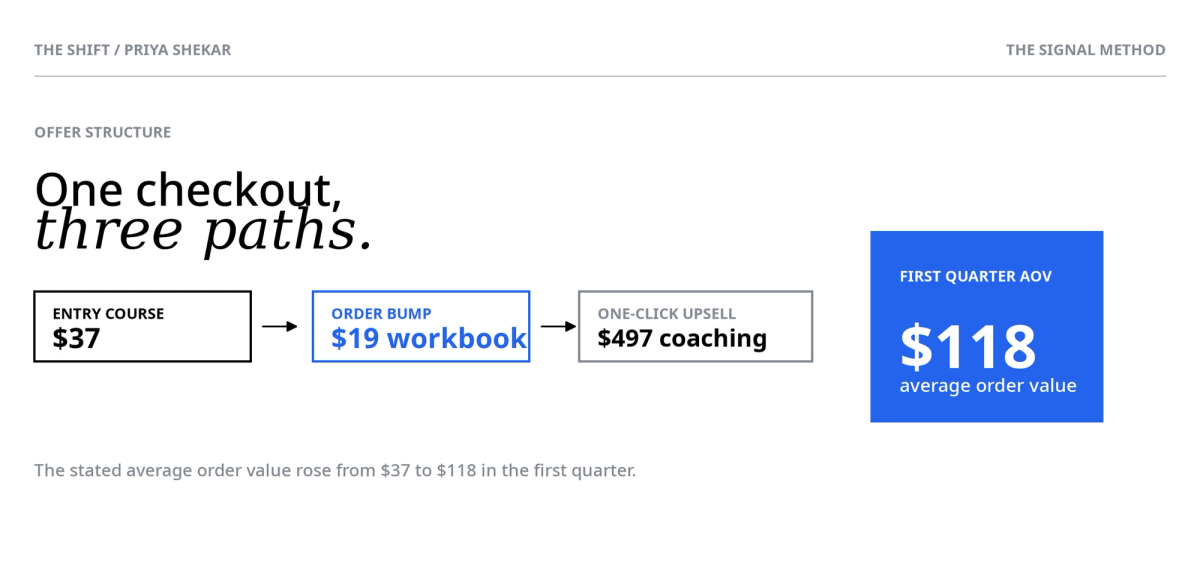
She also stopped treating The Signal Method as a single product and started treating it as a system—a $37 entry course, a $19 workbook order bump, and a $497 group coaching upsell for buyers who wanted more than self-paced material.
But all that restructuring needed a checkout built for more than one price point.
Her original platform charged her extra for every upsell step and gave her no visibility into where buyers dropped off.
So that’s when she decided to move her entire funnel to Digistore24.
The Cart Builder let her add the workbook as an order bump, and the coaching upsell as a one-click add-on—without building three separate checkout pages.
Average order value moved from $37 to $118 in the first quarter alone, and almost entirely from buyers who wanted the coaching add-on but wouldn't have gone looking for it on a separate page.
Digistore24's compliance review also gave her offer a clean bill of health, removing the repeated flagging she'd dealt with under her prior processor.
"That alone bought me back the time I used to spend fighting with support tickets," she said. "I finally had a platform that understood the difference between a mindset course and a medical claim."
The Scale
Once the funnel was stable, Priya listed The Signal Method on the Digistore24 marketplace.
From there, personal development affiliates could see her completion data and her AOV before committing traffic—proof, not promises, which is exactly the pitch she'd built her business on.
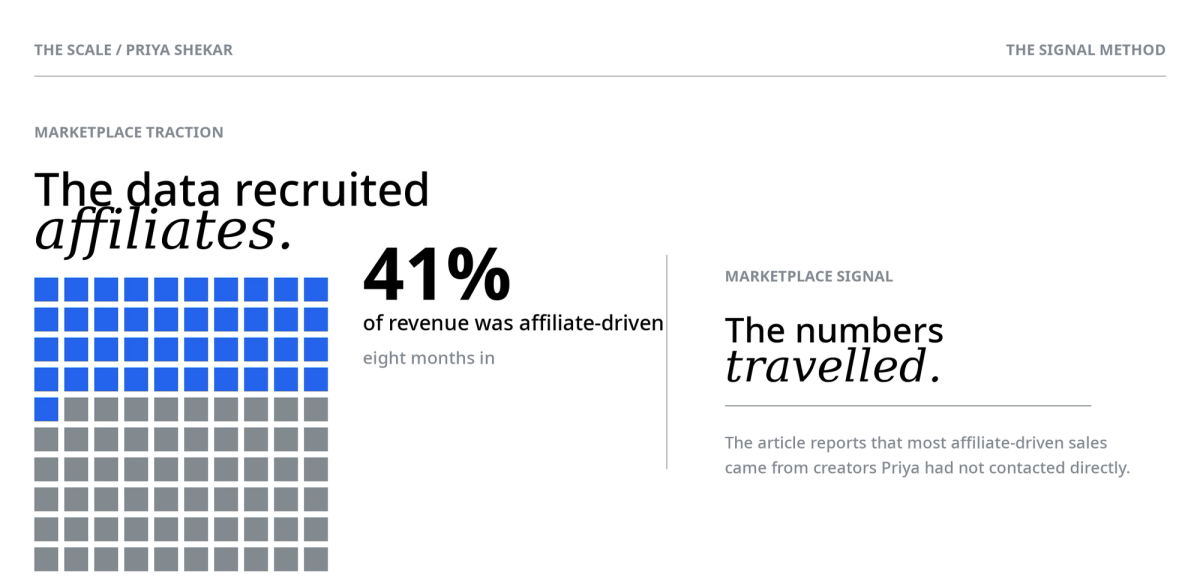
Eight months in, affiliate-driven sales made up 41% of her revenue—sourced almost entirely from creators she had never contacted directly.
A handful of those affiliates even told her that her published completion data was the reason they chose her offer over a competitor with a flashier sales page and no visible numbers at all.
And her group coaching upsell, initially built as an experiment, now accounts for more of her monthly revenue than the original course.
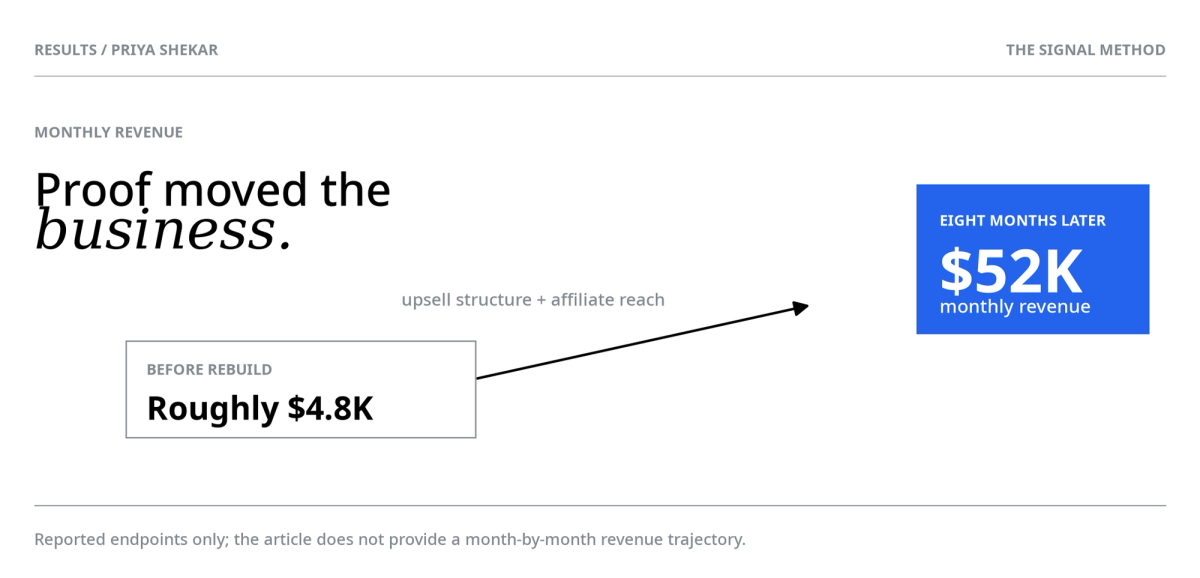
All in all, Priya’s monthly revenue grew from roughly $4,800 to $52,000 over that period, and she attributes most of the growth to the upsell structure and affiliate reach—rather than any single change to the course content itself.
"I didn't change what I taught," she said. "I changed how the business around it was built. The course was always the easy part."
And The Bit She Didn't Expect
What surprised Priya most wasn't the revenue.
It was realizing that the proof-first approach wasn't just supporting her marketing. It was the marketing.
For most of her first year, she treated her completion data and honest copy as a trade-off—the price of refusing to sound like everyone else in her niche. She expected it to always convert a little worse than the hype-driven offers around her, and she'd made peace with that, figuring the tradeoff was worth it for a business she could stand behind.
That assumption held until affiliates started telling her otherwise. Several said they chose her offer over flashier competitors specifically because her numbers were real.
"I thought I'd have to choose between sounding credible and converting well," she said. “But turns out, I didn't have to choose. I just needed a business underneath the course that could actually support more than one price point and more than one kind of buyer. Once I found that, the data did the selling I used to worry only hype could do."
What This Means If You're Building in a Hype-Driven Niche
Personal development rewards big claims more than most categories.
But that doesn't mean proof stops working—it means proof has to compete harder for attention, and the commerce layer underneath it has to carry the weight the sales copy isn’t. It means:
- Publishing real completion or outcome data if you have it—a real differentiator in a category where most offers don't.
- Structuring your offer as a system with more than one price point before you start scaling affiliate traffic, not after.
- Choosing a platform that won't flag legitimate goal-setting or mindset content as a health claim by default.
- Tracking where your revenue actually comes from once affiliates get involved. Priya didn't realize how much her published data was doing the recruiting for her until affiliates started telling her directly.
But none of that can work unless the business underneath the course can keep up.
For Priya, the two payment-processor flags in her first four months and the checkout that penalized her for every upsell step were both solved by the same move: switching to Digistore24.
Compliance review recognized her offer as a mindset course instead of a health claim, and the Cart Builder let her run one price point—or five—without rebuilding her funnel each time. Priya's numbers only started converting once she had a platform that could support the system she'd built.
"I spent a year thinking my copy was the problem," Priya said. "It wasn't. I just needed a platform that could keep up with the business I was actually trying to build."
Ready to Sell With Proof, Not Hype?
Does this sound like you? Then it's time to stop fighting your funnel and your processor and switch to a platform built to handle multi-tier offers, compliance review, and affiliate recruiting in one system.
FAQ
Does Digistore24 support coaching and group programs, not just self-paced courses?
Yes. One-click upsells and order bumps let sellers combine self-paced content, workbooks, and live coaching into a single checkout flow at different price points.
Why do personal development offers sometimes get flagged by payment processors?
Offers that touch on mindset, wellness, or transformation claims are often reviewed more closely because the category overlaps with regulated health and financial claims. A platform with in-house compliance review can reduce false flags on legitimate content.
How fast can affiliates start promoting a personal development offer?
Once an offer is listed on the Digistore24 marketplace, affiliates can review commission rates and performance data immediately and begin promoting without needing to be recruited directly.