

Can your checkout survive a 4,000% traffic spike? One prepper educator's grid-failure story shows why survival sellers need infrastructure built for the worst week, not the average one.
Travis Ward spent eighteen years as a line worker before he started writing about off-grid preparedness. His guide, The Off-Grid Survival Blueprint, had been a steady but unremarkable seller for two years straight—a few hundred sales a month, mostly from search traffic and a small YouTube channel.
But that steadiness was the point, as far as Travis was concerned. He'd built the business around evergreen search traffic precisely because he didn't want to depend on news cycles. "I always assumed the spike, if it ever came, would be a bonus," he said. "I didn't think about it as a stress test for the whole business."
Then, a multi-state grid failure put "How to Prepare for a Blackout" at the top of search results for four straight days.
And what happened to Travis's business that week is the real case study.
Day 1: The Spike Hit
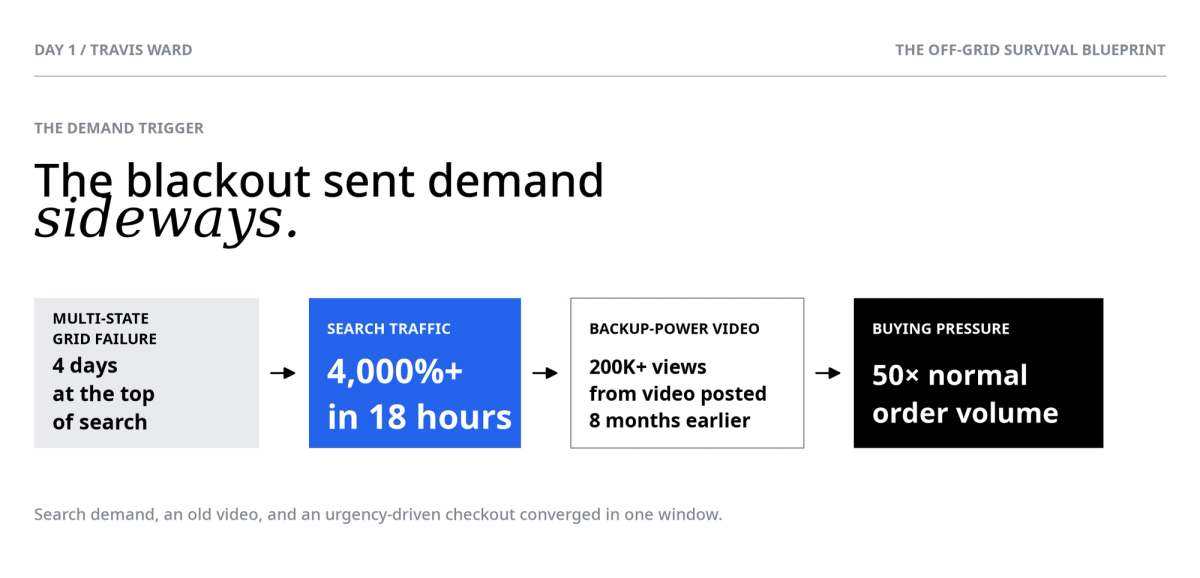
Search traffic to Travis's site jumped over 4,000% within 18 hours of the first outage reports.
His YouTube video on backup power planning—uploaded eight months earlier—went from a few hundred views a day to over 200,000.
And every one of those views was a potential buyer.
But Travis's original checkout, built on a basic storefront tool, wasn't built for the load—or for the fraud risk that comes with sudden, urgency-driven traffic.
"Panic buying is real," said Travis. "But it also brings a wave of impulse purchases that turn into disputes once the panic passes. So I needed a system that could tell the difference between a real buyer and a problem before it became my problem."
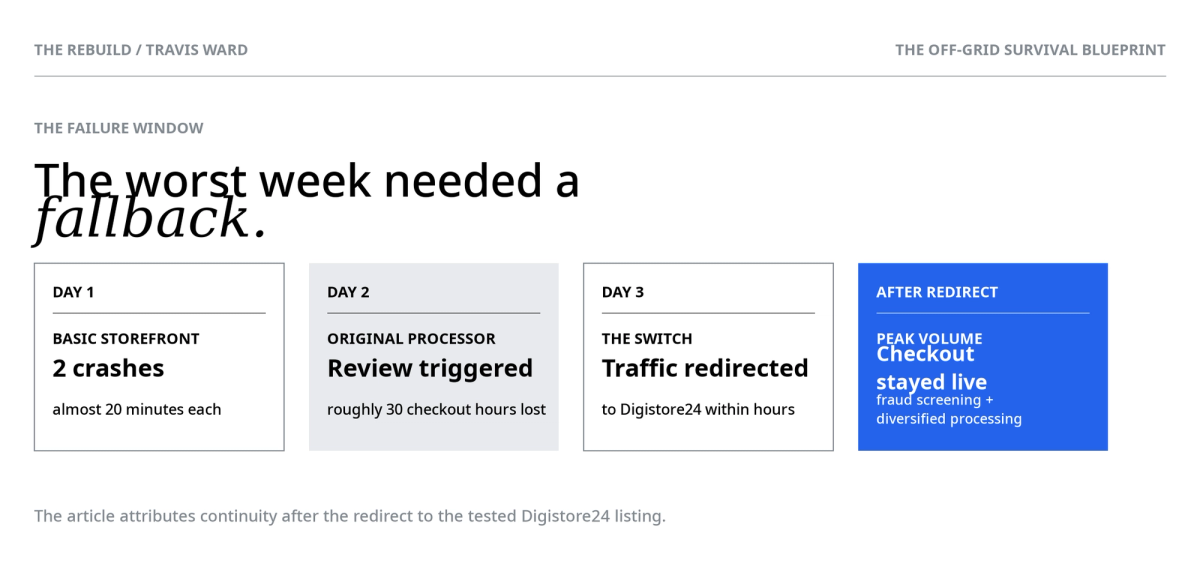
By the end of day one, Travis's site had crashed twice under the load, with each outage lasting almost twenty minutes—and all this during peak search traffic.
Day 2: The Old Setup Starts to Crack
By day two, Travis's original processor had flagged his account for review due to the sudden volume spike—a standard response for a business with no history of that transaction volume, but a devastating one since it was during the exact four days his product mattered most.
As a result, he lost roughly 30 hours of checkout availability during the highest-traffic window of the entire event, with no clear estimate from his processor on when the review would be resolved.
"That's the nightmare scenario in this niche," said Travis. "The traffic is never higher than during a real event, and that's exactly when a rigid processor gets nervous and shuts you down. You spend years building an audience for a moment like this, and then the moment hits, and you watch the traffic all go to someone else's product because yours can't process a sale."
Day 3: Rebuilding on Digistore24
Six months earlier, Travis had migrated a second, smaller product—a foraging guide—to Digistore24 to test the platform on a lower-stakes item before committing his main product.
So when his main checkout went down mid-event, he redirected all traffic to his Digistore24 listing within hours—a decision he credits with saving the week.
The difference showed up immediately:
- Fraud screening flagged suspicious high-volume orders automatically without blocking legitimate buyers, protecting his chargeback ratio during the highest-risk window of the entire spike.
- A diversified processor network meant no single bank's risk tolerance could take his checkout offline, even at 50 times his normal order volume.
- The Digistore24 Marketplace's existing affiliate base in the survival space picked up the traffic surge organically—since several affiliates were already promoting his foraging guide—and added The Blueprint within hours.
- An order bump for a printable quick-reference checklist, already running on his foraging guide for months, took minutes to duplicate onto The Blueprint through the Cart Builder —and quietly lifted AOV through the rest of the spike without Travis needing to write a single new sales page.
- Affiliate payouts kept processing on schedule—even at 50 times normal volume—without Travis manually calculating who was owed what in the middle of the busiest week of his year.
- The checkout itself never went down—even at peak volume—which meant every hour of search traffic that week converted into revenue instead of a bounce.
The Numbers
The chargeback rate rose during the event—as it did across the industry and is very common during any urgency-driven spike—but it stayed well within a manageable range because fraud screening caught the highest-risk orders before they became disputes, rather than after.
What Changed After
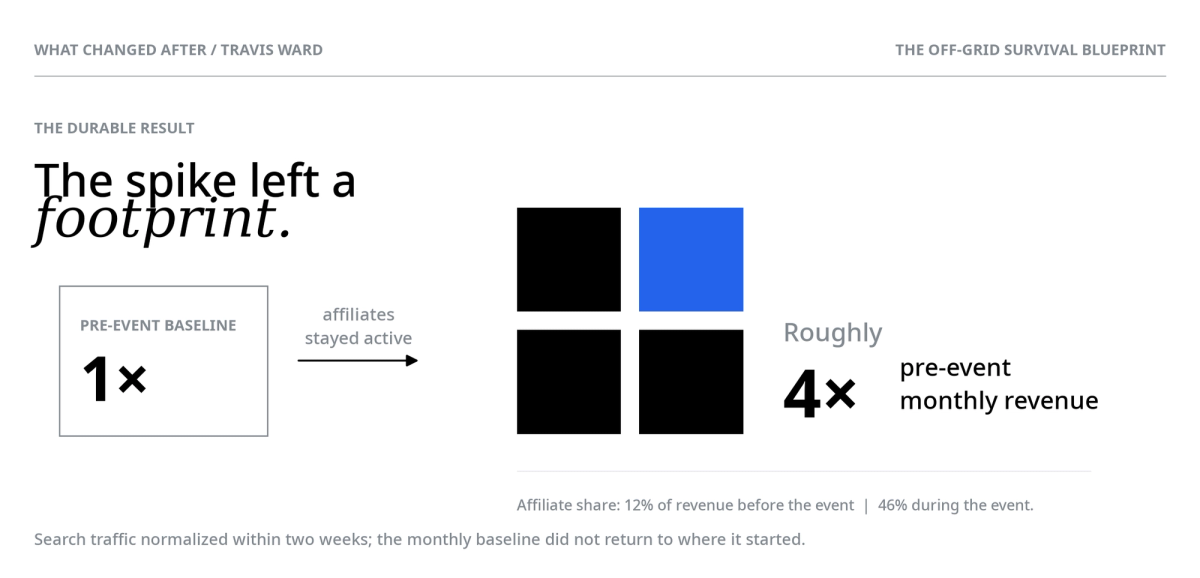
Search traffic normalized within two weeks, but Travis's baseline never returned to where it started.
The affiliates who picked up The Off-Grid Survival Blueprint during the event kept promoting it afterward, and his post-event monthly revenue settled at roughly four times his pre-event average.
"The spike was luck,” he said. “But what I kept afterward wasn’t—that came down to the fact that my checkout was still standing when the traffic showed up."
What would have happened if you hadn't already tested Digistore24 with your foraging guide?
"I don't even want to think about it [laughs]. I'd have been rebuilding a checkout from zero in the middle of the highest-traffic week of my life. Lesson learned: always test your infrastructure before you need it, not during."
What surprised you most about how the event played out?
"How much of the long-term gain came from affiliates, not direct sales. The spike got people to the page. The affiliates who stuck around are what actually grew the business."
Would you change anything about how you prepared?
"I'd have listed the blueprint on Digistore24 a year earlier instead of only testing with the smaller product. I was too cautious about giving up control of affiliate recruiting."
A Preparedness Checklist for Your Business
This is the list Travis now checks before every hurricane season and winter storm forecast:
- Can my checkout handle 50x normal order volume without going offline?
- Does my platform screen for fraud automatically (without needing manual review of every order)?
- Do I already have active affiliates in my niche?
- Is my payment processing diversified enough that one bank's decision can't take my business offline?
Is Your Business Ready to Survive a Spike?
Switch to a platform built to handle sudden volume, fraud screening, and affiliate reach in one system—instead of finding out your checkout can't take the load during the one week it matters most.
FAQ
Why do survival and preparedness products see such extreme demand spikes?
Search interest in this category is closely tied to news events like storms, blackouts, and supply disruptions, which can drive short, intense traffic surges that a seller's infrastructure needs to be ready for in advance.
Does a sudden sales spike put a seller at risk of a processor shutdown?
On processors without a diversified network, a sudden and unexplained volume increase can trigger a manual review or temporary hold. Digistore24's reseller model and diversified processor network are built to absorb volume spikes without single-point failure.
How does the platform handle the higher fraud risk that comes with urgency-driven buying?
Automated fraud screening flags suspicious order patterns in real time, which helps protect a seller's chargeback ratio during high-volume, high-urgency sales periods.