

After 50 Businesses, I Realized I Had Been Doing It the Hard Way
I grew up on a small farm in South Carolina, and I made my first real estate deal at age eleven. By the time I was well into my adult career, I had built more than fifty businesses across wireless phones, data centers, construction, HVAC, GPS leasing, and more industries than most people enter in a lifetime.
Then I stopped starting companies.
Not because I had run out of ideas. Not because I was tired. But because I found something that outperformed everything I had built the traditional way: engineered collaboration.
What I had spent twenty-five years doing the hard way — acquiring capabilities, building reach, generating resources, then deploying them inside a single company structure — I learned to do in a fraction of the time by combining what I had with what others already had.
The CoLAB community grew to over 700 collaborations in just eighteen months. That outpaced my entire twenty-five-year history of starting companies.
If you are a digital product seller, an affiliate marketer, or a creator building on Digistore24, the implication is direct: you do not need to build everything yourself. You need to find the right partners and ask the right questions.
What the VCR Formula Actually Means
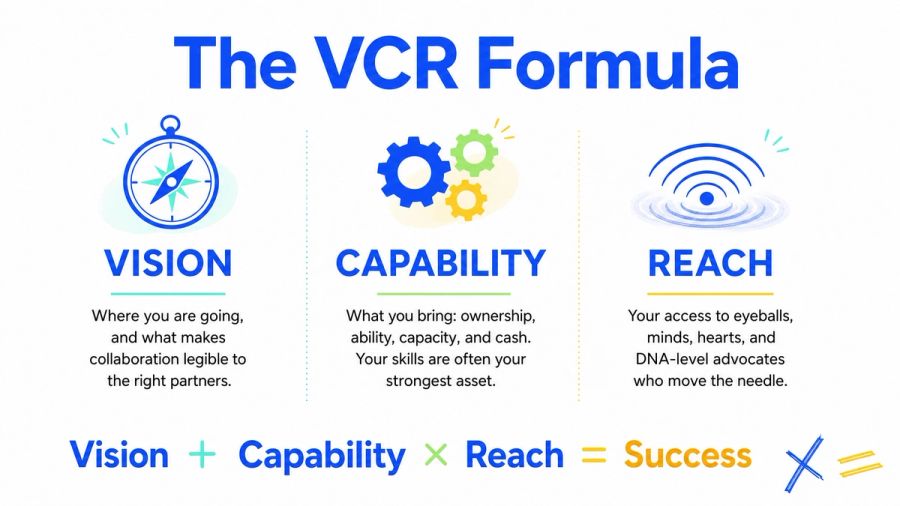
The framework I developed is called the VCR Formula:
Vision + Capability × Reach = Success
It sounds simple, and in structure, it is. But unpacking it changes how you think about growth entirely.
Vision is where you are going. Not just your product roadmap or your revenue goal — but the fundamental answer to "what are you actually building, and for whom?" Vision is what makes collaboration legible to a potential partner. When your vision is clear, the right people can see themselves inside it.
Capability is what you bring to the combination. I break it into four types:
- Ownership (what you possess)
- Ability (what you can do)
- Capacity (what bandwidth you actually have)
- Cash (what you can deploy)
Most entrepreneurs dramatically overestimate their cash capability and dramatically underestimate their ability capability. Your skills and knowledge are often your strongest asset in a collaboration, especially in the digital economy.
Reach is your access to people who can move the needle. Again, four types:
- Eyeballs (raw traffic and attention)
- Minds (people who engage and think about what you share)
- Hearts (people who trust you deeply)
- DNA-level (people who advocate for you as if it were their own mission).
Not all reach is equal, and affiliate marketing is built almost entirely on the distinction between eyeballs and hearts.
The multiplication sign between Capability and Reach is not cosmetic. Reach without Capability produces noise. Capability without Reach produces irrelevance. When you combine them well, the math compounds.
"Stop trying to grow through effort. Start focusing on what you have, combining it with what others have, and ask one question: How do you want to split the outcome?" — Chad T. Jenkins
The WHO Deficiency: What's Actually Blocking Your Growth
Most growth conversations are about:
- What product should I build?
- What channel should I use?
- What price point will convert best?
I want to reframe the question. The most common thing blocking growth for the entrepreneurs and business owners I work with is not a what problem. It is a WHO problem.
They are trying to grow without the right partners, collaborators, or connectors in their corner. They are building in isolation when the missing piece — the reach, the distribution, the credibility — already exists somewhere else.
The WHO deficiency is why most affiliates plateau. They have a strong audience, a proven product, and real traffic. But they are treating every partnership as a simple transaction — here is a commission, go promote — instead of engineering collaborations where both parties' Vision, Capability, and Reach are genuinely combined.
The best affiliate relationships I have seen operate less like referral arrangements and more like joint ventures. Both sides bring something. Both sides structure the outcome intentionally. Both sides grow faster together than they would have alone.
The John Baptiste Say Definition That Reframes Entrepreneurship
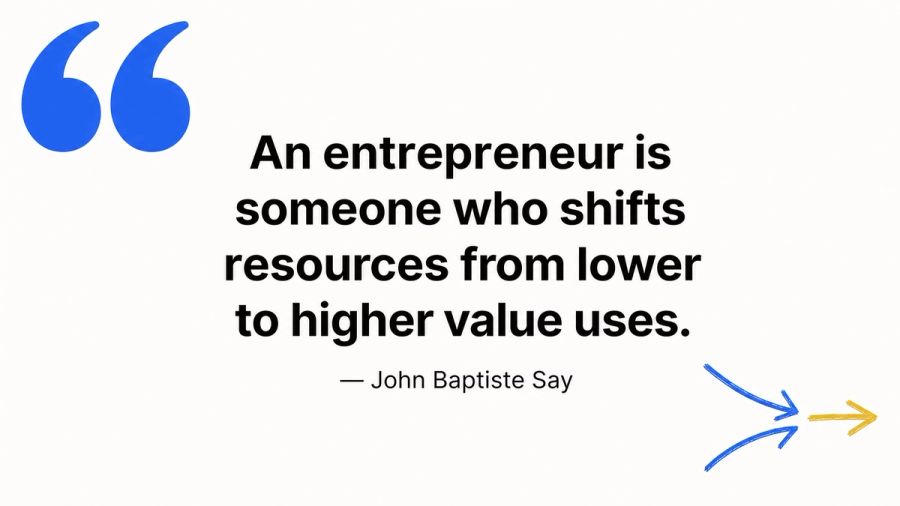
There is a definition of "entrepreneur" from the French economist John Baptiste Say that I come back to constantly: an entrepreneur is someone who shifts resources from lower to higher value uses.
Notice what that definition does not say. It does not say you have to own the resources. It does not say you have to create them from scratch. It says you have to shift them toward higher value.
That reframe is liberating for digital product sellers who feel constrained by what they currently have. You do not need a massive email list, a large ad budget, or an established product catalog to create real value. You need to identify where resources — reach, relationships, knowledge, distribution — are currently underused, and find a way to combine them more effectively.
This is exactly what affiliate programs do at their best. An affiliate with a trusted audience and a proven digital product in a matching niche is a pure example of a resource-shifting collaboration. The product owner has the product. The affiliate has the reach. The combination creates value neither could create alone.
How to Structure a Collaboration Outcome Split
The most practical question in any collaboration is: how do we divide what we build together?
My framework is the 10-20 / 60-80 / 10-20 rule.
The exact percentages flex depending on the deal, but the structure works like this: the person who brings the idea and initiates the collaboration typically takes a smaller share of the outcome. The parties doing the bulk of the execution — building, delivering, marketing — take the middle share. And strategic connectors or IP contributors take the remaining portion.
For affiliate program managers on Digistore24, this is a useful lens for thinking beyond standard commission structures. The most productive partnerships are structured around shared outcomes where each party's contribution is mapped explicitly and the split reflects genuine value creation.
When you tell a potential partner "here is what I have, here is what you have, and here is how we split the result," you are having a fundamentally different conversation than "here is a 30% commission." The first is a collaboration. The second is a contractor arrangement.
Practical Takeaways for Digital Product Sellers
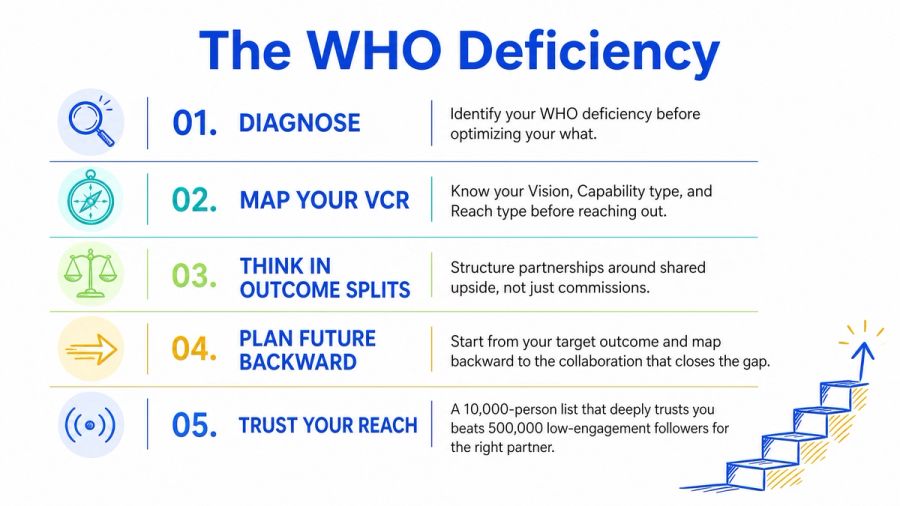
Diagnose your WHO deficiency before you optimize your what. Before you redesign your funnel or test a new ad format, ask: is there a collaboration that could multiply my current reach or capability without the time cost of building from scratch?
Map your VCR before reaching out to potential partners. Know what Vision you are articulating, what Capability type you are leading with, and what Reach type you can offer. Partners do not know what to say yes to if you cannot describe what you bring clearly.
Think in outcome splits, not just commissions. The best collaborations are structured so both parties have genuine upside tied to performance. That alignment changes the quality of the partnership.
Use Future Backward planning to make partner requirements explicit. Start with your target outcome and work backward to the collaboration that closes the gap between where you are and where you are going.
Your reach has more value than you think — in the right combination. A 10,000-person email list that deeply trusts you in a specific niche is more valuable to the right partner than a 500,000-person following with low engagement.
Growth Is an Engineering Problem, Not an Effort Problem
The most durable insight from Chad T. Jenkins's work is also the most counterintuitive: the answer to the growth problem is almost never more effort. It is a better combination.
The digital product economy is filled with talented operators who are working harder than they need to because they have not yet found the right collaborative structure. The product exists. The audience exists. The infrastructure exists. The gap is the relationship that would bring them together productively.
For affiliate marketers, digital product vendors, and creators building on platforms like Digistore24, the VCR Formula is not just a growth framework. It is a different way of seeing the whole landscape — one where every potential partner is a combination waiting to be engineered.
Listen to the full conversation on Unscripted Small Business: Chad T. Jenkins — The Collaboration Formula That Replaced 50+ Businesses. To explore Chad's programs and CoLAB community, start at seedspark.com.
Stop trying to grow through effort. Start building through the right combinations.


