

There's a conversation I keep having with creators.
It doesn't matter if they're dancers, musicians, woodworkers, or course builders. It always starts the same way: they've built something real, they're getting traction, and they still don't think of themselves as a business owner.
That mindset gap is expensive.
Not because there's anything wrong with being a creator — that identity is the source of their best work. But when the business side goes unmanaged, everything from their website to their follow-up emails to their visibility in search works against them. The craft is excellent. The infrastructure is broken. And they often don't know it.
I've spent years working with small businesses and creators through Cyber PR Army, and the single most common problem I see isn't a marketing problem. It's a self-perception problem. Once creators accept that they're running a business, the rest becomes fixable fast. Most of it is surprisingly close to the surface.
The Hardest Shift Isn't the Work — It's the Identity
When I talk to creators about treating their work as a business, I'm not asking them to stop being artists. I'm asking them to hold two things at once.
"It is convincing creators that they are a small business. And it's a really big hurdle because they are creators at heart — whether they are dancers, whether they're making instruments, whether they are writing music."
That hurdle is real, and it's worth naming directly. Creators are often so close to what they make that framing it as a product feels reductive. But the market doesn't know the difference between a creator who takes their business seriously and one who doesn't. Buyers, Google, and the algorithm don't reward effort and passion alone. They reward systems, trust signals, and consistent communication.
For digital product sellers on Digistore24, this same identity tension shows up constantly. You built a course because you know something worth teaching. You created an ebook because you lived through something others need. The product is real. But if your sales page is confusing, your follow-up sequence is nonexistent, and your website is three updates behind, the business is working against you — regardless of how good the offer is.
What "Low-Hanging Fruit" Actually Looks Like
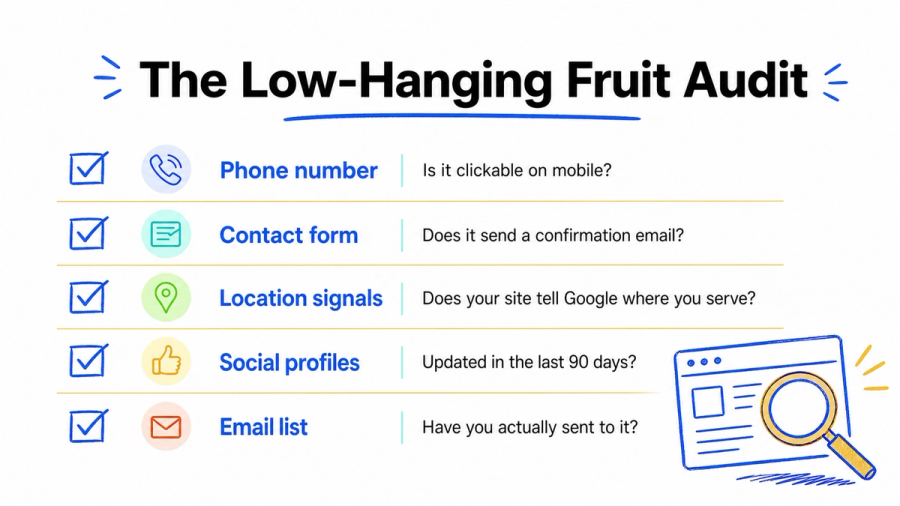
Here's something that surprised me when I started doing detailed audits of small business marketing: most of the problems are basic. Not small — basic. Addressable in a day or a week if someone just points them out.
I call these the granola-first-level fixes.
Each one of these seems minor in isolation. Together, they create friction everywhere a potential customer tries to engage. The creator thinks their marketing isn't working. What's actually broken is the plumbing.
If you're selling digital products through a platform like Digistore24, this translates directly. Your checkout flow, your thank-you page, your post-purchase sequence, and your affiliate-facing materials are all entry points where friction costs you money. Audit them with fresh eyes — or better yet, ask a friend who doesn't know your business to walk through it and tell you where they got confused.
Why Responding Is a Competitive Advantage (And That Shouldn't Be True)

One of the more uncomfortable truths I share with clients is this: in many industries, simply responding to inquiries makes you stand out. Not responding quickly. Just responding at all.
Some industries are so bad at communication that all you have to do is reply thoughtfully and you're already ahead of most of your competition. That's not a compliment to those industries. It's an indictment.
For affiliate marketers and digital product sellers, this applies in two ways. First, if you're running your own offer, your responsiveness to buyer questions, refund requests, and comments shapes your reputation more than almost anything else. A fast, kind response to a complaint often converts a frustrated buyer into a loyal one.
Second, if you're promoting other people's products as an affiliate, your reputation is partially tied to the reputation of what you promote. Choose vendors who respond. Check their support history. Your audience's trust in you is your most valuable long-term asset.
The AI vs. Authenticity Shift That's Already Happening
I've been watching something interesting unfold in digital marketing over the past year. There was a period where AI-generated content was everywhere, and a lot of it was good enough to pass. Now the pendulum is swinging.
People are starting to question what's real. Audiences are developing a sensitivity — not always conscious — to content that feels assembled rather than lived. Creators who are authentically showing up, sharing real experiences, and putting their actual face and voice into their work are standing out in a way that wasn't possible when everyone else was doing the same.
For digital product sellers, this is worth taking seriously. The product pages, email sequences, and affiliate content that performs best right now tends to have a human in it — a real name, a real story, a real result. Generic benefit statements are not converting the way they used to. Specificity, personality, and proof are what cut through.
This doesn't mean avoiding AI tools. It means making sure that whatever you put out has something in it that a language model couldn't have written alone: your experience, your mistake, your specific client result, your honest opinion.
Show Your Roots. People Need to Know You're Real.
One piece of advice I give to local businesses applies just as strongly to digital operators: if you have roots, show them.
Roots mean different things depending on your business. For a local service business, it's your address, your team photos, your involvement in the community. For a digital product creator or affiliate marketer, roots look like: the backstory behind why you built this product, the screenshot of the moment your first sale came in, the podcast interview where someone can hear your actual voice, the LinkedIn profile that confirms you're a real person with a real history.
Buyers — especially first-time buyers who found you through a Digistore24 product listing or an affiliate recommendation — are making a trust decision in seconds. Every authentic signal you provide reduces the friction of that decision. Every generic, anonymous-feeling element increases it.
You don't have to share everything. But share enough that someone can confirm you're real, you know what you're talking about, and you'll still be here tomorrow.
Practical Takeaways for Creators and Digital Product Sellers
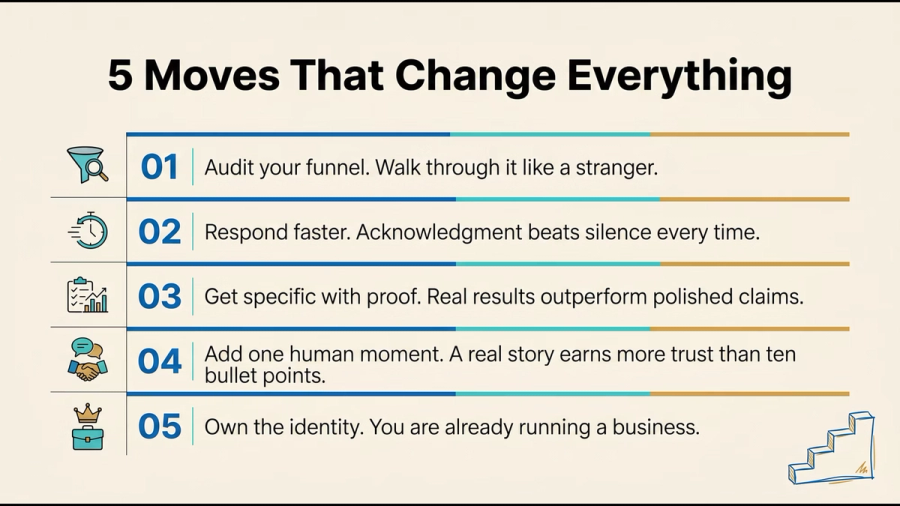
1. Do a basic marketing audit this week. Walk through your website, your sales page, and your email follow-up as if you've never seen them before. Look for broken links, unresponsive forms, missing contact information, and any point where the next step isn't obvious.
2. Respond faster. In most niches, response time is still a genuine competitive advantage. Even an auto-responder that acknowledges an inquiry and sets an expectation outperforms silence.
3. Show proof with specificity. Replace generic testimonials ("This course was great!") with specific results ("I applied chapter 3 and got my first affiliate commission within two weeks"). Specific beats vague every time.
4. Add humanity to your content. One personal story, one honest opinion, or one candid photo in your marketing does more for trust than a dozen polished benefit bullets.
5. Treat your creator identity as a feature, not a liability. The fact that you built this from genuine expertise or lived experience is your differentiation in a crowded market. Lead with that.
The Business Is Already There. You Just Have to Own It.
The creators I've seen make the fastest progress aren't the ones who learn the most tactics. They're the ones who finally accept the premise: I'm running a business. Once that clicks, everything else becomes a solvable problem.
Your digital products, your content, your affiliate relationships — they're all assets in a business you've built. The question isn't whether you're a creator or an entrepreneur. It's whether you're managing what you've already built with the same care you put into making it.
If you're ready to start treating your creative work as the business it already is, Cyber PR Army has free resources to help you get the fundamentals right — and Digistore24's platform is designed to handle the commerce side so you can stay focused on the work that only you can do.


