You've built a digital product that sells.
You've validated the offer, proven the funnel, and started generating revenue.
Now, you want to scale—and you know affiliate marketing is the fastest path there. So why does it feel like the tools you're using are holding you back?
If you're running your program through an affiliate network and watching payouts drip every two weeks, or trying to bolt affiliate tracking onto a Stripe checkout, you already know the problem:
That platform wasn't built for where you're going—it was built for where you started.
This guide is for established offer owners who are ready to move beyond basic affiliate tracking and treat their affiliate program as a genuine growth engine.
We'll cover what modern affiliate marketing software actually does, which features drive real results, and what separates a platform that scales with you from one that creates a ceiling. So, here we go…
What Is Affiliate Marketing Software?
Affiliate marketing software, in short, is a platform that manages the full operational lifecycle of an affiliate program—tracking, commissions, payouts, and compliance—so vendors can scale performance-based sales without scaling their overhead.
While short, that definition is still doing a lot of work. So let’s unpack it a bit:
Most vendors start by thinking of affiliate software as a tracking tool. It records clicks, attributes sales, and reports conversions.
That's table stakes.
What distinguishes serious affiliate marketing software from a basic tracker is everything that sits around the tracking layer—how affiliates find your offer, how commissions are structured and paid, how your checkout is optimized, and who handles the compliance and tax complexity that comes with volume.
According to Grand View Research, the global affiliate marketing platform market was valued at $22.58 billion in 2025 and is projected to reach $35.70 billion by 2033, growing at 5.9% CAGR.
That growth reflects a market that's maturing fast—and the gap between entry-level tools and full-suite platforms is widening with it.
There are, broadly, three types of affiliate software a vendor might consider:
- Standalone tracking tools (e.g., ClickMagick, Voluum) that record traffic and conversions but don't handle payments, affiliates, or compliance—you manage everything else yourself.
- Affiliate networks (e.g., Awin, CJ Affiliate) that connect you with publishers, but typically require technical integration and give you limited control over your funnel and checkout.
- Full-suite affiliate platforms (e.g., Digistore24) that combine tracking, checkout, an affiliate marketplace, payout processing, and compliance into one integrated system.
And for offer owners, this is the category that actually removes the operational ceiling.
Key Features of Affiliate Marketing Software That Drive Real Growth in 2026

Not all features are created equal.
Here's what matters for vendors who are scaling—and why:
1. Tracking—Cross-Device, S2S Postback, Campaign Keys
The tracking layer is the foundation of everything.
Without accurate attribution, you can't optimize campaigns, pay affiliates correctly, or know which traffic sources are actually working.
Modern affiliate marketing software should offer:
- Server-to-Server (S2S) Postback Tracking—fires conversion events directly between servers, bypassing browser-based tracking limitations. This is essential in a post-iOS 14.5 environment where cookie-based attribution is increasingly unreliable.
- Cross-Device Tracking—attributes conversions to the correct affiliate even when a user clicks on mobile and converts on desktop.
- Campaign Keys—allow vendors to track performance by traffic source, creative, or funnel variant, giving you granular data instead of aggregate numbers.
Campaign keys in particular give vendors precise attribution across complex affiliate-driven funnels—something basic trackers don't offer.
Digistore24 supports all three of these natively.
2. Flexible Commission Structures
Rigid commission structures limit the quality of the affiliates you can recruit.
The best affiliates pick offers based on earning potential, and a platform that can only support flat-rate commissions isn't very competitive.
Look for:
- Percentage-based and Fixed Commissions—for different product types and price points
- Tiered or Milestone Commissions—so you can reward high-volume affiliates
- Product-Level Overrides—so you can set different rates for upsells, downsells, and order bumps
Platforms like Digistore24 typically see commission rates of 65–95% or higher for digital products—a figure that reflects the economics of digital goods and the competition for top affiliates.
You can read more on how to set competitive commission rates on the Digistore24 blog.
3. Comprehensive Analytics: EPC, Conversion Rates, Cancellation Rates
Earnings per click (EPC) is the metric top affiliates use to evaluate offers before they promote them. If your platform can't surface EPC data cleanly, then you're making your offer harder to evaluate—and harder to promote.
Strong analytics should surface:
- EPC by affiliate and traffic source—so both you and your affiliates can optimize
- Conversion rates by funnel step—to identify where you're losing buyers
- Cancellation and refund rates—critical for continuity offers and subscriptions
- Revenue per visitor—the vendor-side equivalent of EPCs
Native Conversion Tools: Split Testing, Order Bumps, Upsells
This is where most vendors feel the pain of being on the wrong platform.
Basic checkout tools—whether that's a Stripe integration or an older network's order form—don't let you test.
Most advanced affiliate marketing software includes native tools for:
- Split testing pricing and order form variants—test a $47 vs. $67 price point without a third-party tool
- Order bumps—add-on offers presented at checkout that increase average order value without additional traffic
- One-click upsell sequences—post-purchase offers that capture additional revenue from buyers already in the buying mindset
Digistore24's Conversion Cockpit is built specifically for this, along with many other incredible features.
Vendors can split-test products, pricing, order forms, and upsell sequences natively—no integrations required, no extra cost.
Solving the Affiliate Acquisition Challenge: Accessing High-Quality Promoters

The problem most affiliate guides don't talk about honestly is that the top affiliates in any niche are already on a handful of platforms.
And if your offer isn't on one of those platforms, you’re essentially invisible to them.
Affiliate management tools help you manage the affiliates you already have—but an affiliate marketplace helps you find the ones you don't.
This distinction matters more than most vendors realize.
Chasing individual affiliates through cold outreach is slow, unpredictable, and doesn't scale. The vendors who grow the fastest are the ones who list their offer in a marketplace where high-intent affiliates are actively searching for products to promote.
Digistore24's marketplace gives vendors instant visibility to 100,000+ active affiliates.
These aren't dormant accounts—they're affiliates actively looking for offers, evaluating EPCs, and promoting products.
For a vendor moving from a smaller network or a private program, this is a step-change in accessible affiliate quality—not just an incremental improvement.
So, when you’re evaluating affiliate marketing software, don’t just ask, "How does it manage my current affiliates?—ask: "How does it help me find new ones?"
The Cash Flow Game-Changer: Why Payout Speed Matters

Payout speed is underrepresented in most affiliate software comparisons—and it really shouldn't be.
For a scaling vendor, payout timing is a cash flow problem in disguise.
Most platforms operate on Net-30 terms, meaning revenue generated this month reaches you next month—at the earliest. Bi-weekly payouts are better, but still create a lag between when you're reinvesting in traffic and media and when that revenue lands.
The math on this becomes significant at scale:
- You run a campaign that generates $100K in revenue this month.
- On Net-30 terms, that money arrives in 30+ days.
Meanwhile, you still need to fund next month's ad spend and operations in the meantime. At volume, this lag compounds—it means you're always funding growth on last month's cash.
Faster payouts solve this problem.
Digistore24 offers payouts up to 4x per month—compared to the bi-weekly or Net-30 standard on most competing platforms.
So for vendors reinvesting aggressively in paid traffic or scaling media budgets, the difference between waiting 30 days and receiving funds four times per month isn't a convenience feature—it's a material business advantage.
When comparing affiliate marketing software, payout frequency should sit right alongside fee structure as a primary evaluation criterion, not a footnote.
Beyond Payments: The Operational Freedom of a Merchant of Record
Here's what happens when you scale an affiliate program without a Merchant of Record (MoR) in place: tax, VAT, payment processing, and chargeback management become your problem—aka: your headache.
At low volume, it’s totally manageable.
But at high volume—we’re taking multiple markets, significant affiliate traffic, and international buyers—it becomes operationally unmanageable.
When your platform operates as an MoR, those functions are removed from your operational plate entirely.
But this is the operational reality that most affiliate software comparisons skip over.
Tools like Stripe put you right in the merchant seat—you own the tax compliance for every jurisdiction you sell into, the chargeback process, and the payment processing risk.And that's manageable when you're selling domestically at modest volume. But when you're pushing offers internationally with a hundred active affiliates driving traffic from different geographies, it becomes a significant burden.
Digistore24 operates as a full MoR in both the US and EU.
That means US sales tax, EU VAT, chargebacks, and payment processing compliance are handled automatically. And it's included in the platform's all-inclusive commission fee—not charged separately, and not bundled into an enterprise tier.
For vendors planning to sell internationally or at high volume, this should be one of your highest-leverage decisions when selecting a platform.
Choosing the Right Affiliate Marketing Software: A Vendor's Checklist for 2026

Here’s a checklist you can use to help evaluate affiliate marketing software for your business.
The criteria are ordered by strategic impact, not by how prominently platforms typically promote them.
- Affiliate Network Size and Quality: How many active affiliates can discover your offer? Is it a managed network or a marketplace with organic discovery? What's the average EPC of top offers on the platform?
- Payout Frequency: What are the default payment terms? Weekly, bi-weekly, Net-30? Is a faster payout available, and at what threshold? How does this affect your ability to reinvest in growth?
- Merchant of Record Coverage: Does the platform handle US sales tax and EU VAT? Who manages chargebacks? Is compliance included in the standard fee or added separately?
- Native Conversion Tools: Can you split-test pricing, order forms, and upsells without external tools? Are order bumps and post-purchase upsells built in? Does the platform provide funnel performance data natively?
- Tracking Capability: Does the platform support S2S postback tracking? Cross-device attribution? Campaign-level keys for granular optimization?
- Pricing Model: Is it a monthly subscription, revenue share, or transaction fee? Are there hidden costs for compliance, payouts, or integrations? What's the all-in cost at your current and projected volume?
- Product Type Support: Does the platform support digital downloads, memberships, subscriptions, physical products, and services? Are upsell and cross-sell sequences supported for your product type?
- Migration Risk: Is there a migration pathway if you're switching from another platform? Can you run the new platform in parallel while you evaluate? Is there a setup cost or minimum commitment?
Obviously worth noting… Digistore24 meets all eight of these criteria with no monthly fee—meaning the risk of testing it alongside your existing setup is effectively zero. And the Digistore24 Migration Service provides one-on-one support to ensure your offer is optimally configured from day one.
Digistore24 vs. The Alternatives: What Serious Vendors Need to Know
Here's a direct comparison of Digistore24 against the platforms most established vendors are considering or currently using. The focus is on the factors that matter most at scale.
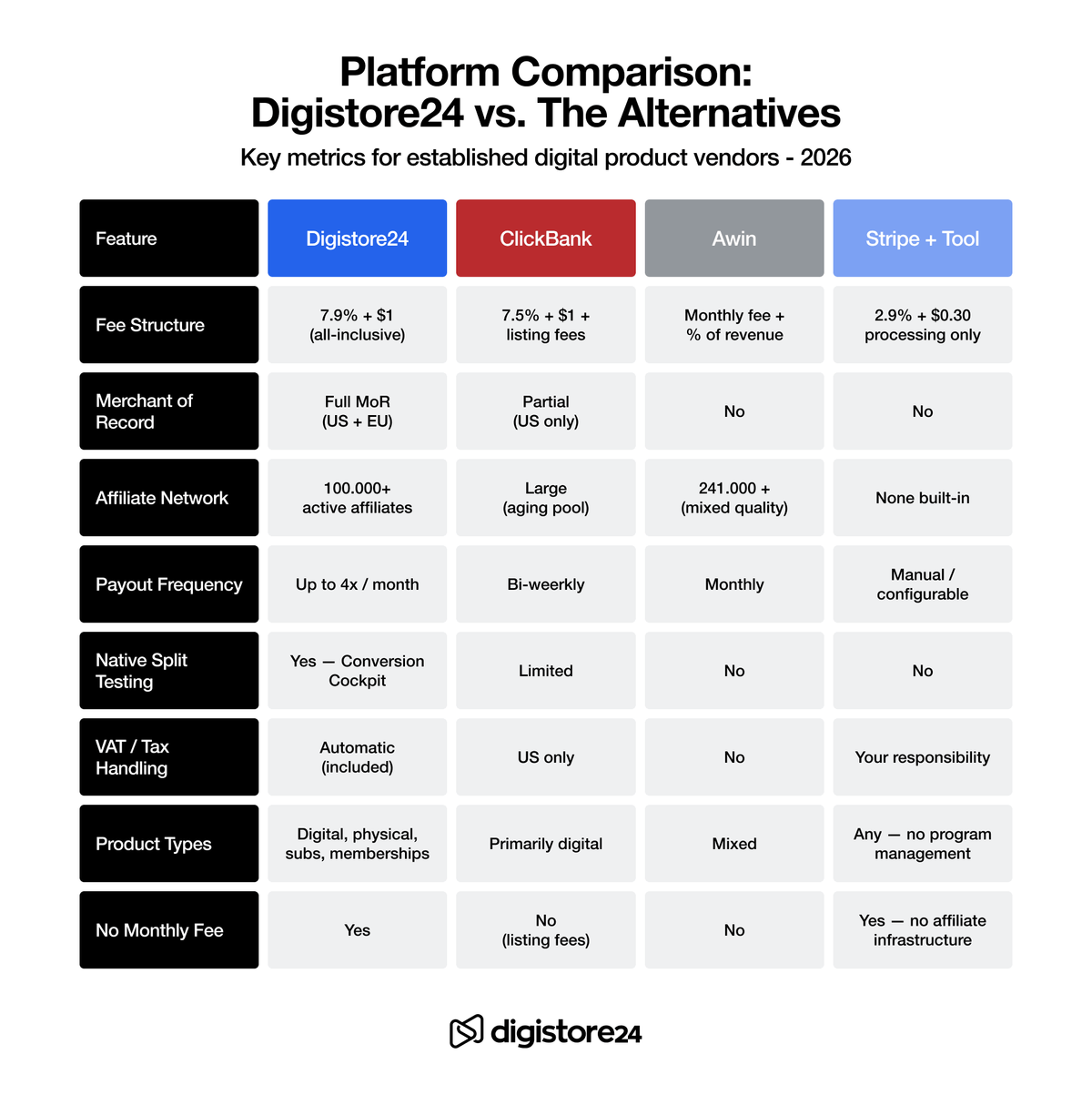
The critical difference for scaling vendors:
Digistore24 is the only platform in this comparison that combines a large active affiliate marketplace, full MoR coverage, native conversion tools, and frequent payouts into one all-inclusive offering with no monthly subscription.
For a vendor moving off ClickBank or Stripe, the transition to Digistore24 doesn't require abandoning what's working—it means adding a platform that removes the current constraints that are slowing you down.
Setting Up Your Affiliate Program for Maximum Scale
Once you've selected your platform, the setup quality determines how fast your program can grow. Here's what matters beyond the basics:
Step 1: Product Configuration and Approval
Make sure you get your product approved and configured correctly from the start.
This includes accurate product descriptions, clean checkout flows, and compliant marketing claims. Platforms with MoR responsibilities (like Digistore24) review products before they go live—so treat this as a quality gate, not a bureaucratic hurdle.
Step 2: Set Commission Rates Strategically
Your commission rate is your primary tool for attracting top affiliates.
Research the going rate in your niche, then consider going slightly above it to give affiliates a reason to choose your offer over a similar one.
Step 3: Build Out Your Advertising Area
Top affiliates don't want to build creatives from scratch. Your advertising area should include:
- High-converting banner ads (multiple sizes)
- Email swipe copy
- Social media copy and image assets
- Promotional video scripts or clips
- Key selling points and FAQs
The more you reduce the work required to promote your offer, the more affiliates will actually promote it.
Step 4: Configure Your Full Funnel—Including Upsells
An offer with a strong upsell sequence will have significantly higher EPCs than the same offer without one.
Affiliates track this.
A funnel with a $47 front-end and a well-converting $97 upsell will pretty much always outcompete a standalone $47 offer.
You can use Digistore24's Conversion Cockpit to configure and split test:
- Front-end pricing variants
- Order bump placement and copy
- Upsell and downsell sequences
Step 5: Leverage Joint Ventures and Cross-Upsells
One of the most underused growth mechanisms on full-suite platforms is the joint venture model—this is where two vendors cross-promote each other's products as upsells within their respective funnels.
Digistore24 supports this natively, allowing vendors to set up cross-upsell arrangements that generate incremental revenue without additional ad spend.
And for vendors with complementary offers in adjacent niches, joint ventures can be one of the highest-ROI activities on the platform.
Scaling Without Limits

The right affiliate marketing software doesn't just run your program—it determines how far your program can go.
Basic tracking tools will tell you what happened.
But a full-suite affiliate platform with a live marketplace, fast payouts, native conversion tools, and MoR infrastructure will change what's possible.
If you're currently dealing with delayed payouts that limit your ability to reinvest, an affiliate pool that feels tapped out, or a checkout infrastructure that limits what you can test—these aren't minor inconveniences.
They're fundamental, structural limits on your growth.
Digistore24 is built to remove those limits:
- 100,000+ active affiliates ready to promote your offer
- Up to 4 payouts per month—so cash flow supports your ambitions rather than constraining them
- Operating as full Merchant of Record in the US and EU—so compliance doesn't scale into a full-time job.
- Native conversion tools that let you optimize the entire funnel without stitching together third-party integrations.
- No monthly fee.
- No minimum commitment.
- And zero risk to test it alongside your current setup.
So…
Are you ready to find out what your offer can do with the right platform behind it?
FAQ
What is affiliate marketing software?
Affiliate marketing software is a platform that manages affiliate tracking, commission payments, affiliate recruitment, and compliance for businesses running performance-based marketing programs. Full-suite platforms also handle checkout, split testing, and in some cases sales tax and VAT as a Merchant of Record.
What features should I look for in affiliate marketing software?
For established offer owners, the most important features are: accurate S2S postback tracking with cross-device attribution, an active affiliate marketplace (not just a management layer), fast payout frequency, native conversion tools like split testing and upsells, and Merchant of Record coverage if you sell internationally.
What is a Merchant of Record in affiliate marketing?
A Merchant of Record (MoR) is a platform or entity that legally processes transactions on your behalf, handling sales tax, VAT, chargebacks, and payment compliance. Using an MoR removes significant operational overhead for vendors scaling into multiple markets.
How does Digistore24 compare to ClickBank for vendors?
Both platforms serve digital product vendors, but Digistore24 offers up to 4x/month payouts vs. ClickBank's bi-weekly schedule, full EU and US MoR coverage, native split testing via the Conversion Cockpit, and an all-inclusive fee with no separate listing costs.
What is the best affiliate software for digital product businesses in 2026?
The best affiliate software for digital product businesses combines an active affiliate marketplace, fast payouts, native conversion optimization tools, and full compliance handling in one platform. Digistore24 is the leading option for vendors who need all of these capabilities without a monthly subscription fee.
How do I set up an affiliate program on Digistore24?
After creating a vendor account and getting your product approved, you configure commission rates, build out an advertising area with promotional materials, set up your upsell sequence, and list your offer in the marketplace. The Digistore24 Migration Service provides one-on-one support for vendors moving from another platform.