I've been doing this for fifteen years across legal, health, pet care, nonprofit, and more. The pattern behind expensive mistakes is almost always the same: businesses treat marketing as a to-do list.
Post on Tuesday. Send a newsletter once a month. Run an ad in November.
When leads slow down, they scramble to add more items. More posts. A new platform. A paid campaign. But they rarely stop to ask: is this actually working? What am I measuring?
That's the difference between marketing as a task and marketing as a business process — and it separates businesses that grow predictably from ones stuck in the feast-and-famine cycle.
At WR Digital Marketing, every engagement starts with that question. Because tactics without process are just spending money in the dark.
The Platform Problem Nobody Wants to Admit

Here's the uncomfortable number: organic social media reach for most business accounts sits somewhere between 1% and 2%. If you've built a following of ten thousand people on Instagram or Facebook, and you post something today, roughly 100 to 200 of those people will see it. Without paying to promote it.
That number has dropped steadily for years, and there's no reason to expect it to reverse. Social platforms are businesses. Their incentive is to get you to pay for reach, not to give it away. And that incentive isn't going away.
This doesn't mean social media has no value. It does, particularly for brand awareness, discovery, and community building. But it is not a reliable channel for reaching your own audience at scale. It's a rented space where the landlord controls who sees your content and when.
Email is different. Your list is yours.
If you have 10,000 email subscribers and you send a message today, most of them will receive it — and a meaningful percentage will open it. You can segment, personalize, automate, and measure in ways that social platforms simply don't allow. And nobody can algorithm you out of your own subscriber's inbox.
For digital product sellers on platforms like Digistore24, this isn't abstract. Your email list is the core retention and reactivation asset for your business. It's how you warm up buyers for your next launch. It's how you deliver bonus content that increases course completion rates. It's how you build the relationship that makes a one-time buyer want to buy again.
Email as a Retargeting Bridge
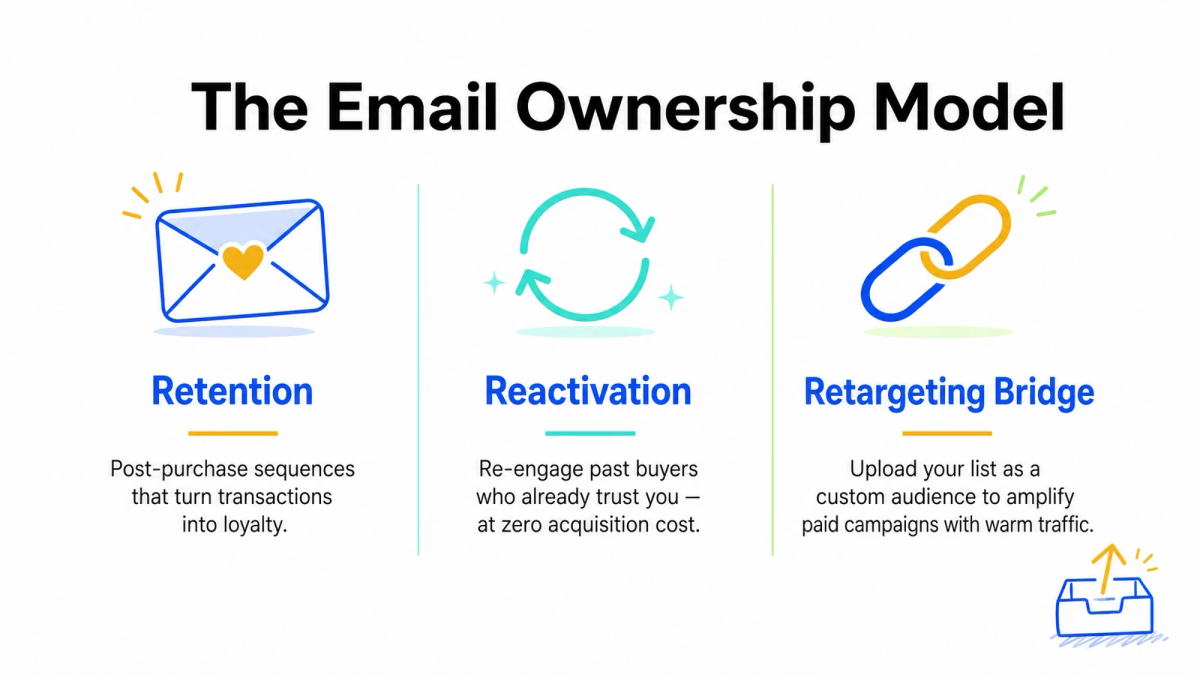
One of the most underutilized strategies I see with small business owners is using their email list as a custom audience for paid campaigns. Most people think of email and paid ads as separate buckets. They're not — or at least, they don't have to be.
When you upload your email list to a platform like Facebook or Google and create a custom audience, you're retargeting people who have already opted in to hear from you. The conversion rates on these audiences are significantly higher than cold traffic, and the cost per acquisition is lower, because these people already know who you are.
This is what I mean when I say email is the bridge. It's not just a communication channel — it's an identity layer that connects your organic audience to your paid campaigns, your affiliate promotions, and your product launches.
If you're running affiliate traffic to a Digistore24 offer, this matters a lot.
Building an email list on the front end of that traffic — even with a simple lead magnet — gives you a retargetable, reachable audience that you own regardless of what happens to the original traffic source.
Why "Existing Customers" Is Always the Best Segment
When I take on a new client, one of the first things I ask is: when did you last reach out to your existing customers?
The answer is usually uncomfortable. Sometimes it's been months. Sometimes they've never done it systematically. And yet those people have already made the highest-trust decision in the sales process: they bought from you. They decided you were worth their money.
Re-engaging that segment almost always produces faster, cheaper results than any acquisition campaign. These people don't need to be convinced you're legitimate. They don't need extensive social proof. They need a reason to come back — a new offer, an update to something they already bought, a relevant resource, an honest check-in.
For digital product sellers, this means your post-purchase email sequence is not optional. The emails that go out after someone buys from you are doing more work for your long-term business than most of your acquisition campaigns. They're building the relationship that turns a transaction into loyalty.
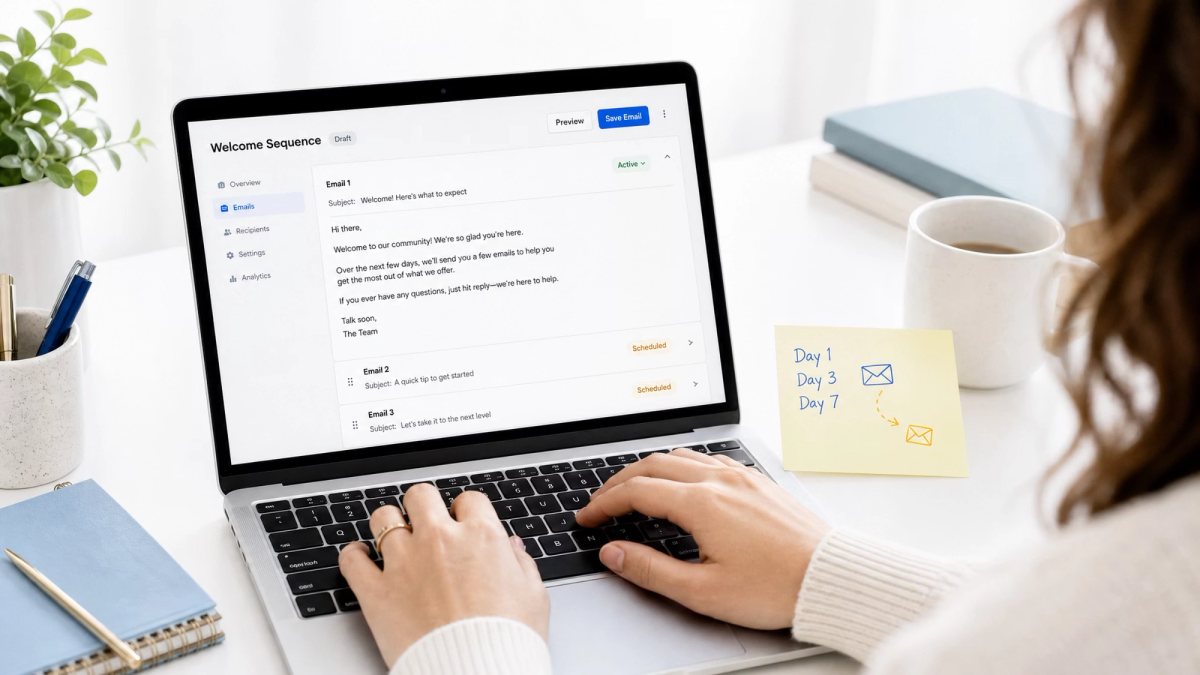
A simple sequence might look like: welcome and quick win on day one, a tip that reinforces why they made a good decision on day three, a community invitation or upsell on day seven, and a results check-in at day fourteen. That's four emails. Four touchpoints that most businesses never send.
Local vs. National: Own a Smaller Pond
One framework I use with clients is owning a regional pond versus chasing a national ocean. A local business that dominates its geographic market is in a far better position than one trying to compete nationally without a content moat or domain authority.
The same principle applies to digital niches. The affiliate marketer who is the definitive resource for "affiliate marketing for fitness coaches" outperforms the one competing on "affiliate marketing" broadly. The course creator who owns a specific segment — "email marketing for independent therapists" — converts better than one targeting everyone.
Specificity creates authority. And authority creates the kind of organic traffic that compounds without requiring constant paid amplification.
Stop Treating Marketing as a To-Do List

The feast-and-famine cycle happens because businesses market when they need leads and stop when they're busy. Breaking it means treating marketing as a business process with defined inputs, measured outputs, and consistent execution regardless of how busy you are today:
- A content calendar planned in advance, not assembled the morning of
- An email send on a regular cadence, not when you remember
- A paid campaign running at a baseline level always, not just during launches
- A monthly review with adjustments made from data
Random execution produces random results. Systematic execution produces learning — and learning produces improvement.
Practical Takeaways for Digital Product Sellers
1. Start or recommit to your email list today. If you're not actively building it, you're building someone else's platform. Even a simple lead magnet and a weekly send is a better foundation than any social strategy.
2. Use your email list as a retargeting audience. Upload it to Facebook or Google and run a small campaign to your existing subscribers before spending on cold traffic.
3. Build a post-purchase email sequence. A four-to-six-email sequence starting the day someone buys from you will improve retention, reduce refunds, and increase lifetime value.
4. Reach out to your existing customers. Before your next launch, email your past buyers first. They convert at higher rates and they cost you nothing to reach.
5. Measure before you optimize. Define what success looks like for each marketing channel — open rate, click rate, revenue per subscriber, cost per lead — and track it consistently before drawing conclusions.
The Channel You Own Is the Channel That Compounds
Every social platform you build on is one algorithm change away from becoming a much smaller audience. Every SEO ranking you earn is one Google update away from shifting. Every paid campaign runs only as long as you're paying for it.
Your email list compounds. Every subscriber you earn stays in your list, can be reached again, can be segmented and personalized, can be connected to every other campaign you run. It's the one channel where you are the one who decides when and who gets the message.
For digital product sellers building a real business — not just a single launch — email ownership is foundational. Everything else amplifies it. Nothing replaces it.
If you're ready to build the systems that actually support consistent growth, start with WR Digital Marketing's free SMB toolkit and explore how Digistore24's platform integrates with email tools to put your follow-up on autopilot.