

I Fell Into Content Marketing by Accident — and $75,000 Followed
I graduated during the 2009 recession with degrees in English and Psychology. The job market was thin. I took what I could find, which turned out to be writing blog posts for a law firm.
I was not doing anything particularly sophisticated at the time. I was writing clearly, consistently, and with a real understanding of what the firm's potential clients were actually searching for and worried about. After six months, the attorney came back to me with something that changed how I thought about content entirely.
He told me I had brought in $75,000 worth of new business to his firm — just through the blog posts I was writing.
I did not set out to prove a case for content marketing. I just wrote useful things for a specific audience. But the result was undeniable: strategic written content, published consistently, directly influenced whether clients called that firm or kept scrolling.
For digital product sellers and affiliate marketers who are skeptical about content as a revenue driver, I want that number to land. Not as a guarantee — results depend on execution — but as a proof of concept. Content is not just brand awareness. Content is how buyers decide who to trust before they ever reach your checkout page.
The Psychology Behind Why Content Converts
My degree in psychology was not the obvious path to content marketing. But it turned out to be the most relevant training I have for this work, because content marketing is fundamentally a psychological process before it is a technical one.
People do not buy products. They buy solutions to problems they already feel. They buy futures they want for themselves. And before they buy anything, they need to feel understood — that the person or brand offering the solution actually gets what they are experiencing.
That is what good content does. It enters the conversation already happening in the reader's mind. It names the problem accurately. It reflects the reader's situation back to them in a way that creates recognition: "Yes, that is exactly where I am."
Once a reader feels understood, trust starts to build. And trust is the bridge between "this looks interesting" and "I am going to buy this."
For Digistore24 vendors building digital product sales funnels, this is not abstract. Every piece of content in your funnel — your landing page copy, your email sequence, your blog posts, your video scripts — is either building that trust or failing to. The question to ask about every piece is: does this make my reader feel understood before I ask them to act?
"After six months, he came back and told me that I had brought in $75,000 worth of business to his law firm just through the blog posts I was writing for him." — Alison Ver Halen
Information Gain: The Concept That Separates Good Content from Generic Content

Here is the standard I use when evaluating whether a piece of content is worth publishing: does it add information gain?
Information gain is the idea that your content needs to contribute something — a unique perspective, a lived experience, a specific example, a counterintuitive insight — that the reader could not have gotten from a generic overview. In an era where AI tools can produce technically correct summaries of any topic in seconds, information gain is the only thing that makes your content irreplaceable.
ChatGPT can write a serviceable article about email marketing best practices. It cannot write about the specific campaign you ran, the results you got, the thing that surprised you, and what you would do differently. That specificity is what builds authority. That is what search engines and readers are increasingly rewarding.
Google's E-E-A-T framework (Experience, Expertise, Authoritativeness, Trustworthiness) is often misunderstood as a technical checklist — schema markup, author bios, credential pages. But in practice, E-E-A-T signals come from how you write, not just what tags you attach. First-person experience woven naturally into your content is the signal. The structured data is secondary.
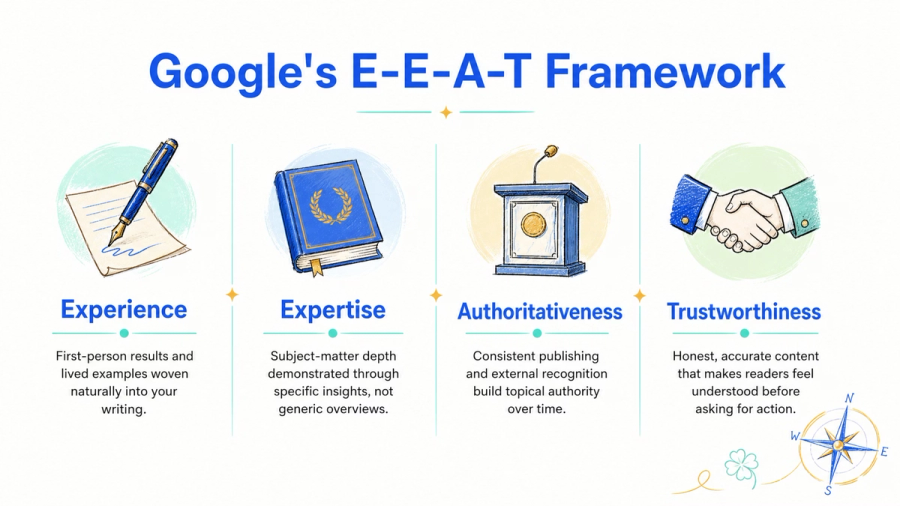
For digital product sellers creating content to support your offers, this means: your personal results matter. Your specific examples matter. The case study with real numbers matters far more than the polished overview that could have been written by anyone.
Don't Propose on the First Date: Matching CTAs to the Buyer Journey
One of the most common conversion mistakes I see in content marketing — and in digital product funnels specifically — is CTA mismatch.
A visitor arrives at a blog post from a search query. They are early in their research. They are curious, not committed. And at the bottom of the post, they are asked to book a sales call.
That is proposing on the first date. It is not that the offer is bad — it is that the timing destroys the relationship before it starts.
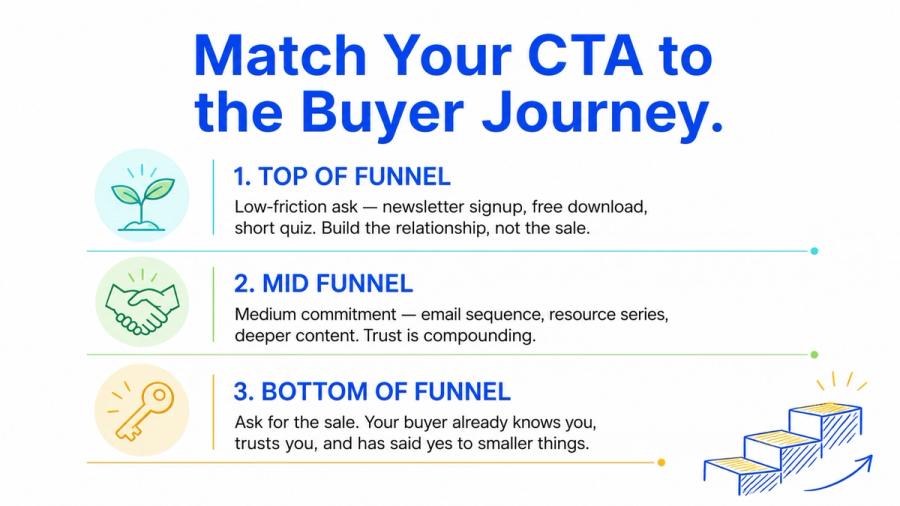
The fix is matching your call-to-action to where the reader actually is in their journey. For top-of-funnel content — a blog post, a social share, an introductory video — the appropriate CTA is something low-friction and high-value: a newsletter signup, a free resource download, a short quiz or assessment. You are asking for a small commitment that moves the relationship forward, not a large one that scares off someone who is not yet ready.
As the prospect moves deeper into your content ecosystem — reading multiple posts, downloading resources, engaging with your email sequence — the appropriate ask escalates naturally. By the time you ask for the sale, they have already said yes to several smaller things. The trust has been established. The commitment feels like a natural next step, not a cold pitch.
For affiliate marketers, this framework applies to how you structure your pre-sell content. A comparison article, a case study, or a detailed tutorial that delivers genuine value before the affiliate link earns far more conversions than a thin piece that exists only to push traffic toward an offer.
Practical Takeaways for Digital Product Sellers

Treat your content as a trust-building system, not a traffic mechanism. Traffic is a byproduct of trust. Content that builds genuine understanding and credibility will generate traffic as a secondary effect. Content built purely for traffic rarely builds trust.
Add information gain to everything you publish. Before publishing any piece of content, ask: what is in here that the reader could not have gotten from a generic overview? If the answer is nothing, revise before publishing.
Match your CTAs to the buyer journey. Top-of-funnel content earns small commitments — email signups, free downloads, low-stakes next steps. Mid-funnel content earns medium commitments. Only bottom-of-funnel content should be asking for the sale.
Write from experience, not just expertise. You do not have to be the leading authority on a subject to write usefully about it. Specific, honest accounts of what you tried, what happened, and what you learned are exactly what readers — and search algorithms — are increasingly looking for.
Consistency compounds in ways that single pieces cannot. The $75,000 result came from six months of consistent blogging, not a single viral post. The compounding effect of regular, quality content builds authority that one-off campaigns cannot replicate.
Build Content That Earns the Sale Before It's Asked For
The most powerful thing content marketing can do for a digital product business is eliminate the hardest part of selling: introducing yourself to a skeptical stranger and asking them to trust you enough to buy.
When your content has been doing that work over weeks and months — answering questions, demonstrating expertise, delivering value before asking for anything in return — the eventual sale feels like a natural conclusion rather than a pitch. Your buyer already knows you. They already trust you. They have already decided, in many cases, before they ever reach the buy button.
That is what Alison Ver Halen's law firm client experienced. The blog posts did not just drive traffic. They built the case for trust over six months, so that by the time a reader became a client, the decision was almost already made.
Listen to the full conversation on The Unscripted SEO Interview Podcast: Killing Content Marketing Strategy In the Age of LLMs with Alison Ver Halen. To explore Alison's content marketing approach and book, visit avwritingservices.com.
Build content that earns trust. Let trust do the selling.


