

Most digital product creators think about distribution exactly once: right after launch, when they realize no one is buying.
That's the wrong sequence — and it's an expensive mistake to make at scale. Distribution is not a marketing problem you solve after a product exists. It's an architectural decision you make before you write the first line of copy.
The operators who figure that out early — who design their products with affiliate reach, email ownership, and owned-audience infrastructure built in from day one — are the ones who outlast every platform algorithm change, every ad cost spike, and every market saturation cycle.
I've seen this play out across five exits and two decades of building digital businesses. The products that scaled were rarely the most polished or technically sophisticated. They were the ones that traveled.
If you're building a digital product right now and distribution isn't baked into the design, you're solving the wrong problem.
The Conversion Optimization Trap (And Why It's So Easy to Fall Into)
Here's what happens when you build for conversion and only for conversion.
You get very good at extracting value from traffic. Your funnel tightens. Your ROAS improves. Your email sequences get sharper. And in the process, you become completely, structurally dependent on a traffic source you don't control — whether that's Google organic, a Facebook ad account, an affiliate network you're buying from rather than owning, or an Amazon listing that can be suspended without notice.
Conversion optimization is a real skill. I'm not dismissing it. But conversion without distribution is a treadmill. You keep paying to keep the machine running, and the moment you stop, revenue stops.
Consider two hypothetical digital product businesses — both doing $500K/year.
- Business A has a 4% conversion rate on cold traffic and spends $8K/month on paid acquisition.
- Business B has a 2.5% conversion rate but has spent two years building an email list of 40,000 engaged subscribers and a podcast with 8,000 regular listeners.
- Business A stops growing the moment the ad budget gets cut.
- Business B generates revenue regardless of what Google or Meta decide to do tomorrow.
Distribution compounds. It creates assets that work harder over time, not just while you're actively running them. One depreciates when you stop feeding it. The other compounds while you sleep.
Three Properties of a Product Built for Distribution
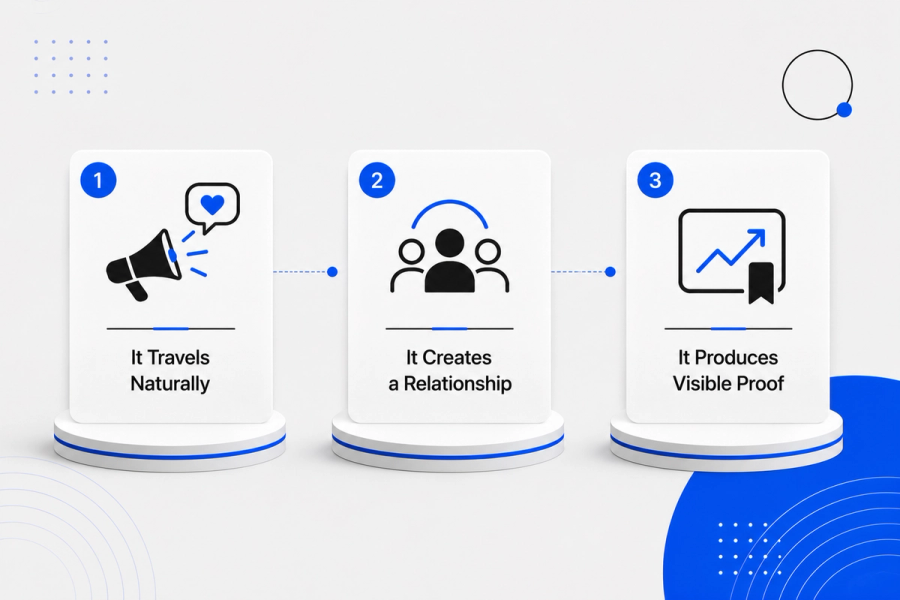
A product built for distribution has three structural properties. Most digital products have one, or none.
First: it travels naturally. When someone benefits from it, they tell people — not because you asked them to, but because the product gives them something worth talking about. This isn't about referral mechanics or affiliate commissions alone. It's about designing an outcome so specific and so remarkable that organic word-of-mouth is the natural result.
Traffic Think Tank is my clearest example. The community produced genuinely better SEO practitioners, and those practitioners talked about it everywhere — in forums, on Twitter, at conferences. The product was the distribution. We didn't need to spend heavily on acquisition because the members themselves were the acquisition channel.
Second: it creates a relationship. One-time transaction products are the hardest to build distribution around because you have to restart the acquisition machine for every sale. Products that create ongoing relationships — communities, subscriptions, courses with live cohorts, tools with network effects — build an owned audience as a byproduct of delivering value. Every renewal, every login, every session is a distribution event that costs you nothing marginal.
Third: it produces visible proof. Results that users can show or share are distribution built into the product design. A certification. A revenue screenshot. A before-and-after outcome. A publicly attributable transformation. These create earned media and social proof that does marketing work you'd otherwise have to pay for separately.
If your product doesn't have at least two of these three properties, you're building for conversion only — and that treadmill doesn't have an off switch.
The Coordination Layer Question Every Seller Should Ask
When I evaluate which digital products will command durable valuations — as an operator or as an investor — the question I'm asking is whether a product sits at the coordination layer between supply and demand, or upstream of it.
Products that control the coordination layer are structurally defensive. They're how buyers find sellers, how creators reach audiences, how information moves from producers to consumers. Affiliate networks, marketplaces, membership communities, newsletter platforms — these are coordination-layer assets. They become more valuable as they get larger, and they create switching costs that pure content or software products simply don't have.
Products upstream of the coordination layer — standalone courses, single-use digital downloads, one-off tools — are great starting points. But they're inventory, not distribution assets. You still need to find a coordination layer to sell through, and whoever owns that layer extracts margin from you.
The strategic question for every product creator: are you building inventory, or are you building toward the coordination layer? If you're building inventory right now — which is often the right place to start — what's your concrete path toward owning more of the pipeline?
How Digistore24 Fits Into This Picture
I'll be direct about why I'm at Digistore24, because it's directly relevant to this argument.
Digistore24, with its 950,000 vendors and five million users, is a coordination layer. It connects digital product creators with buyers and affiliates at a scale that almost no individual operator can replicate independently. When you publish a product on Digistore24, you're not just listing something for sale — you're plugging into a distribution network with relationships, trust signals, and audience reach already built in.
That's meaningfully different from building a standalone Shopify store and driving cold traffic to it yourself.
But — and this is the critical caveat — plugging into someone else's distribution is a starting point, not a destination. The operators who use platform distribution intelligently are the ones building their own owned assets in parallel: growing their email list from every transaction, cultivating affiliate relationships they can carry with them, creating brand search volume that makes customers seek them out by name. Use the coordination layer. Just don't become permanently dependent on it.
The Sequence I'd Run If I Were Starting Today
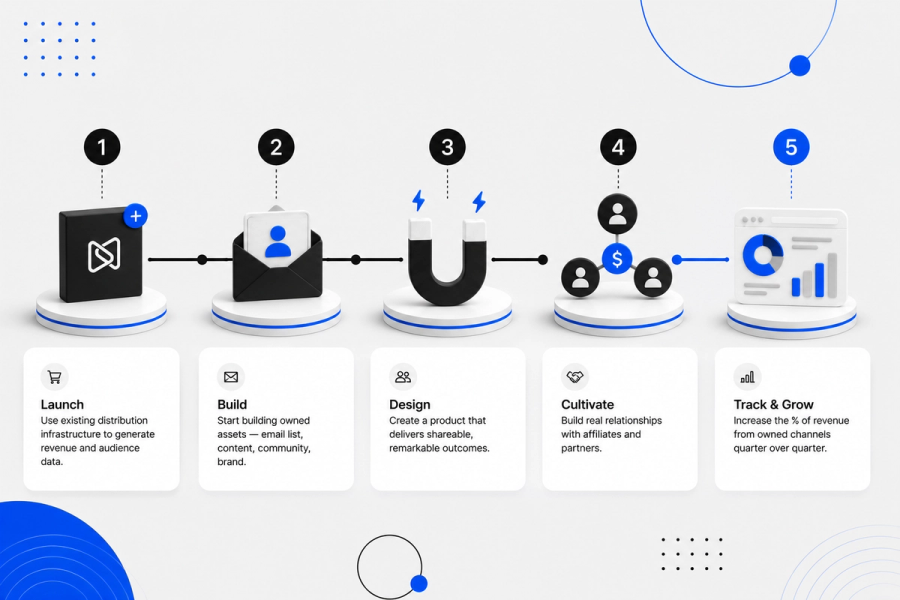
If I were building a digital product business from scratch right now — which, honestly, is one of the most exciting things to contemplate given what AI has done to the cost of building — here's the sequence I'd run.
One: Launch on existing distribution infrastructure to generate initial revenue and audience data. Don't try to build your own platform from day one. The goal of the first 90 days is learning, not owning.
Two: Immediately start building the assets you'll own permanently — an email list, a podcast or YouTube channel, a community, a brand. These take time to compound, which means the time to start them is before you need them.
Three: Design your product to produce visible, shareable outcomes, so that customers become the distribution.
Four: Cultivate affiliate relationships, not just affiliate traffic. The difference is whether you own the relationship with the affiliate partner or whether you're just another offer in a network.
Five: Track what percentage of your revenue comes from owned channels versus rented ones. If the owned percentage isn't growing quarter over quarter, you are not building distribution — you're running a more sophisticated version of the traffic treadmill.
"The businesses that commanded the highest multiples weren't the ones with the best products or the most revenue — they were the ones that owned how demand found them." — Nick Eubanks, CMO, Digistore24.
The math on this is simple. Businesses with owned distribution are worth more, are more resilient to platform changes, and have more strategic options when it's time to exit or reinvest. Build toward that from day one — not as an afterthought when you realize the ad account isn't enough.


