

Beyond the basics—structure, incentives, legal requirements, and building a referral program that grows with your business
Word-of-mouth has always been the highest-converting marketing channel—and a referral program is how you systematize that.
Done well, a referral program turns satisfied customers into active promoters and brings in new buyers at a fraction of the cost of paid acquisition.
But there are two versions of referral programs: One that caps out at a few hundred customers sharing discount codes, and another that scales into an automated affiliate engine driving consistent, compounding revenue.
Most guides only tell you about the first one.
But this guide covers both—the practical setup steps every business needs, and the strategic evolution that separates referral loops from real growth systems.
So whether you’re just building your first referral program or looking to scale an existing one, this guide is designed to leave you with a clear path forward.
Let’s start with the basics.
What Is a Referral Program?
A referral program is a structured system in which existing customers are incentivized to recommend a product or service to new customers, with both parties receiving a reward when the referral converts.
Firstly—and importantly—referral programs and affiliate programs are not the same thing.
- Referral programs are typically customer-to-customer and driven by personal recommendation.
- Affiliate programs are a business-to-promoter model where content creators, publishers, and marketers promote your offer to their audiences in exchange for a commission.
The two share the same underlying mechanics—track, convert, reward—but operate at different scales and with different audiences. But we’ll talk more about that later.
The data behind referral marketing in 2026 is hard to argue with.
According to research from McKinsey and DemandSage, referral programs generate 3–5x higher conversion rates than other marketing channels, and referred customers have a 37% higher retention rate than customers acquired through other means.
The average referral marketing campaign earns a 5.7x ROI—yet most businesses either don't run a formal referral program or they run one that leaks value because it was never properly structured.
This guide shows you how to fix that.
So let’s dive in.
1: Define Your Goals and Identify Your Ideal Referrer

Every successful referral program starts with a clear answer to two questions:
What do you want it to achieve? Who are you asking to refer?
Set SMART Goals
Vague objectives produce vague results. So before you configure a single link or write a single incentive, define what success looks like in specific terms.
Common referral program goals include:
- Lower customer acquisition cost (CAC)—set a target CAC you want to hit and then benchmark that against your current paid channels
- Increase customer lifetime value (LTV)—referred customers typically have higher LTV, so track cohort behavior separately
- Grow revenue by a specific percentage within a defined window—a realistic first-year target is a 10–25% increase in new customer acquisition
- Reduce dependence on paid advertising—this one’s useful for businesses where ad costs are climbing, and organic isn't scaling fast enough
Identify Your Ideal Referrer
Not all customers are equally likely to refer, and not all referrals are equally valuable. Your best referrers tend to be customers who:
- Have been using your product long enough to have a genuine opinion
- Have already had a meaningful result or outcome from your offer
- Belong to a community or network that contains your target buyer
For digital product businesses—courses, software, memberships, ebooks—your ideal referrer is usually someone who has completed a purchase, had a clear win, and is still engaged with your brand.
That's the profile you want to activate first.
2: Choose the Right Structure and Incentives
Once you know what you're trying to achieve, the next step is to design a program people actually want to participate in—which comes down to two things: how it's structured, and what you're offering in return. Get either one wrong, and participation stays low no matter how well you promote it.
When it comes to a referral program’s structure—who gets rewarded and when—there are two main models:
One-sided programs reward only the referrer when their contact makes a purchase. These are simpler to run but tend to have lower participation rates because there's no visible incentive for the new customer to act on the recommendation.
Two-sided programs reward both the referrer and the referred customer.
Over 78% of active referral programs now use a double-sided structure, because when both parties have something to gain, the referral becomes a genuine offer rather than a favor.
Choosing The Right Incentive
The incentive is the mechanism that drives behavior, and the right one depends on your margins, your customer psychology, and your product type.
- Cash or Account Credit—Works best for SaaS, subscriptions, and services. It's high motivation and maps directly onto your CAC math.
- Percentage Discounts—Best for e-commerce and lower-ticket digital products. Easy to communicate, but watch the margin impact at volume.
- Free product or upgrade—A strong fit for memberships and software tiers. High perceived value for the referrer, low actual cost to you.
- Exclusive Access—Works well for communities and high-value programs where the appeal is status and scarcity, rather than monetary reward.
- Commission Per Sale—This is usually the move when you're scaling into affiliate territory; at this point, the program’s shifted from a referral loop to a performance model.
Calculating Incentive Value
Your incentive should generally be worth less than your current CAC from other channels, but feel meaningfully valuable to the referrer.
So if you're currently paying $60 per customer acquisition through paid ads, an incentive of $20–$30 per successful referral is strong economics.
- For B2B referral programs, where deal values are higher, cash incentives of $50–$200+ are common.
- For digital products, it’s easier because the numbers work in your favor. When your margins are strong (70%+), you can offer a genuinely attractive incentive and still come out well ahead on every sale it drives.
3: Design Your Mechanics and Rules

This is where referral programs either build trust or fall apart.
Clear mechanics are the difference between a program people actively share and one they sign up for and forget about.
Decide on Your Core Tracking Mechanism
Every referral program needs a way to attribute a new customer to a specific referrer. The two most common methods are:
- Unique Referral Links—Each participant gets a unique URL that tracks clicks and conversions. This is the standard for digital products and online services.
- Referral Codes—Alphanumeric codes that new customers enter at checkout. These are easier to share verbally or in social content, but not quite as easy as a one-click link.
For digital products, unique links are almost always the better choice. They demand no action from the new customer beyond the actual click, and they allow you to track the full journey from click to conversion.
Define Your Rules Upfront:
- Eligibility—Who can participate? First-time buyers only? Active subscribers? Any customer?
- Reward Triggers—When does the reward fire? On click, on purchase, on first payment received, or after a refund window closes?
- Fraud Prevention—Self-referrals (using your own link to buy) are common, so you need to explicitly define that they're disqualifying and build a check into your system.
- Expiry—Do referral links expire? Does the incentive expire if not claimed within a window?
- Reward Timing—When does the referrer receive their reward? Immediately on conversion, or after a hold period?
Remember: user experience matters.
The more friction in the sharing process, the lower the participation rate. Sharing should require one click, not three screens.
And the referral landing page should clearly explain what the new customer gets, not just what the referrer gets.
4: Select Your Tools — When to DIY, When to Scale

This is the decision point most guides skip over. The right tool depends entirely on your scale, product type, and growth ambitions.
Basic referral software is good for getting started.
For businesses in the early stages of a referral program—or those with primarily physical products and a small customer base—dedicated referral tools handle the fundamentals cleanly.
Options like ReferralCandy, Friendbuy, and Extole provide tracking links, reward automation, and basic analytics. They're easy to configure, integrate with major e-commerce platforms, and require minimal technical setup.
But the limitations become clear when you start to scale:
- Payout management—handling hundreds or thousands of cash payouts manually or through limited payout tools becomes operationally intensive.
- Tax compliance—Basic referral tools don't do this, and if your referrers earn above certain thresholds, you're legally required to collect W-9s and issue 1099s.
- International payouts—paying referrers in different countries introduces currency conversion, withholding tax, and VAT complexity that standard tools just aren't built for
- Affiliate-quality tracking—server-to-server (S2S) postback tracking, cross-device attribution, and campaign-level keys aren't available on most referral platforms
- Fraud detection—as programs grow, so does gaming, so you want to make sure your tools have sophisticated fraud detection.
But when it’s time to upgrade, you’ll want an affiliate platform and a Merchant of Record (MoR).
For businesses selling digital products—courses, ebooks, memberships, software, coaching programs—a basic, standalone referral tool isn’t usually fit for purpose. What you need there is a full affiliate platform that operates as a Merchant of Record (MoR).
An affiliate platform with MoR functionality replaces basic referral software by handling automated commission payments, global payouts, tax compliance, and fraud detection as part of a single integrated system. So basically, all that complicated nitty-gritty stuff is done for you.
That’s why Digistore24 is the natural evolution for digital product businesses.
Instead of cobbling together a referral tool + payout processor + tax tool + fraud management, with Digistore24 you get:
- 100,000+ active affiliates in its marketplace—so you don't just manage referrers, you gain immediate access to a network of proven promoters actively looking for offers to promote
- Automated commission payments with up to 4 payouts per month—no manual processing, no payout backlogs
- Full MoR coverage in both the US and EU—US sales tax, EU VAT, and chargeback management are handled automatically
- Native conversion tools, including split testing, order bumps, and one-click upsells—all things that are simply unavailable in basic referral software
A DIY referral program builds a small network of customer advocates.
But a platform like Digistore24 gives you instant access to a virtual army of affiliates—promoters with existing audiences, ad spend, and marketing infrastructure—all ready to drive revenue without you needing to recruit them one by one.
- A referral program relies on customers sharing with their personal network.
- An affiliate program relies on structured promoters—publishers, content creators, and media buyers—marketing to their own audience in exchange for performance-based commission.
Here’s the difference:
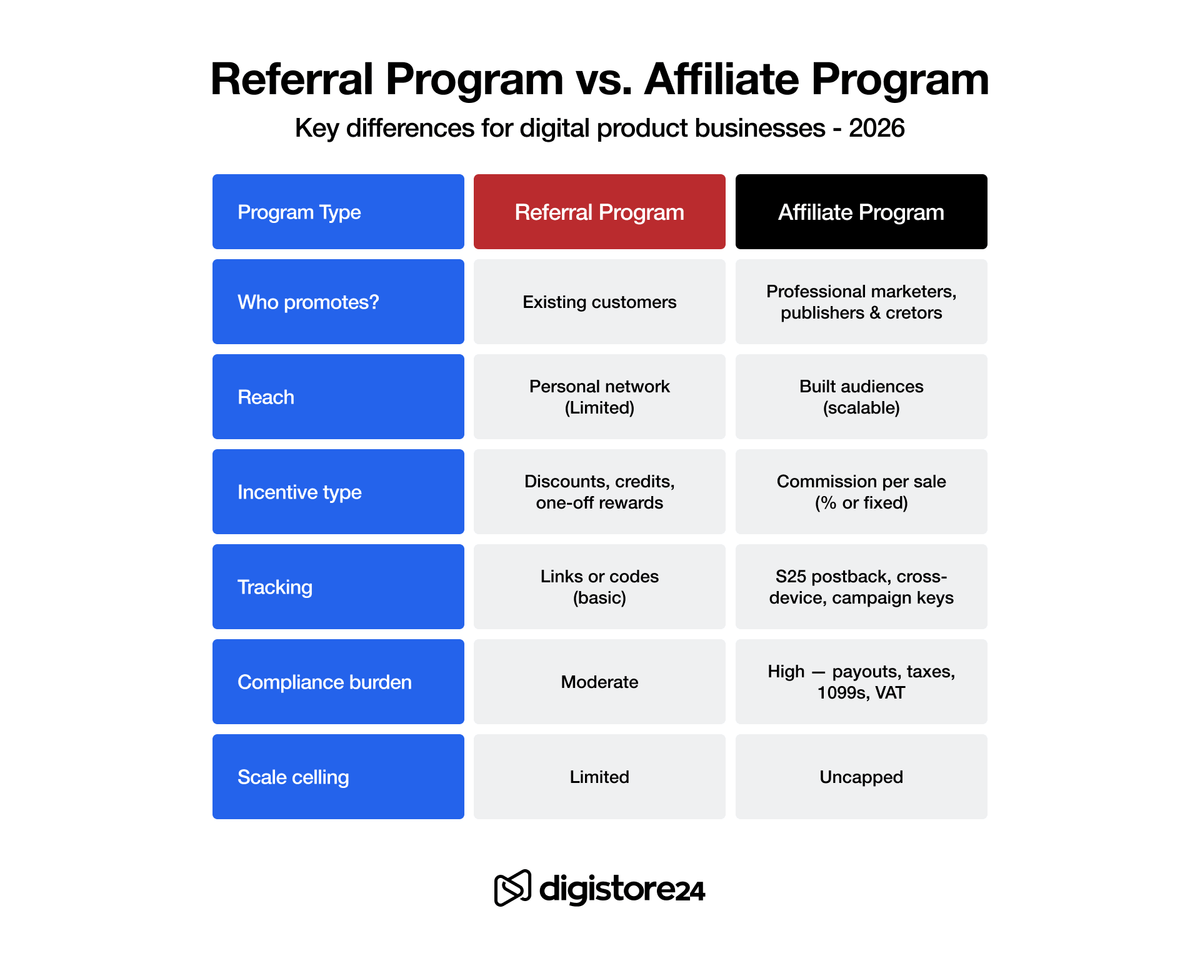
Most businesses start with referral programs and graduate to affiliate programs as they scale.
The transition point is usually when the customer base is large enough to generate meaningful referral volume, the operational burden of managing payouts and compliance outweighs a simple tool's capabilities, or the business wants access to promoters outside its existing customer base.
For digital product businesses, that transition usually happens sooner than expected.
If you're selling an online course or membership with decent margins, a well-promoted affiliate listing can outperform years of customer referrals within months.
5: Launch and Promote Your Program
A referral program that no one knows about doesn't generate any referrals. So promotion should be systematic—not a one-off announcement.
At launch, use every channel you own:
- Email your customer list—this is your highest-intent audience. Send a dedicated launch email explaining the program, the incentive, and exactly how to participate. It could be something as simple as this:
That's it. Short, direct, concrete. If it takes more than 30 seconds to understand, rewrite it. Keep it simple: one link, one action.
- Post-purchase flow—the moment after a customer completes a purchase is when enthusiasm is highest. So introduce the referral program in your order confirmation email or thank-you page.
- In-product or in-member-area placement—for software and memberships, place a persistent referral prompt inside the product—it keeps the program visible without being intrusive.
- Social announcement—share the program on your owned channels with a clear value proposition for both referrer and referee.
For businesses on Digistore24, our affiliate marketplace handles a significant part of this challenge automatically.
So rather than building a promotional audience from scratch, your offer is immediately visible to 100,000+ active affiliates browsing the marketplace for products to promote.
6: Track, Analyze, and Optimize
A referral program that isn't measured isn't managed.
These are the KPIs that matter.
Core referral program KPIs:
- Participation rate—the percentage of eligible customers who have shared at least once. A program with a 5–15% participation rate is healthy; above 20% is excellent.
- Referral conversion rate—the percentage of referred visitors who complete a purchase. The industry median is 3–5%; top programs can achieve 8%+.
- Cost per referred acquisition—divide total incentives paid out by the number of new customers acquired through referrals. Then compare this to CAC from paid channels.
- Referral program ROI—this is the revenue generated from referred customers minus total incentive cost. The benchmark average is a 5.7x ROI.
- Referred customer LTV—track your referred customer cohorts separately. Referred customers typically have 16–25% higher lifetime value than non-referred customers.
Key optimization levers:
- A/B test your incentive—test cash vs. discount vs. credit to see which drives higher participation and conversion
- Test referral message framing—the copy of your sharing prompt will affect the share rate significantly—benefit-led framing ("Give your friend $20, get $20") will pretty much always outperform a generic call to action (CTA).
- Optimize the referral landing page—a page specifically designed for referred visitors converts significantly better than a generic homepage.
- Adjust reward timing—programs with real-time reward fulfillments see a 42% increase in participation.
For businesses on affiliate platforms—like Digistore24—advanced analytics considerably expand the optimization surface.
EPC (earnings per click), cancellation rates by affiliate, and campaign key tracking allow you to identify which promoters are driving high-quality buyers—and which are driving refund volume.
That’s the kind of data that enables real optimization at scale. And it’s the kind of detail that just isn't available with basic referral tools.
The Hidden Risks: Legal, Tax, and Compliance

This is the section most referral program guides skip. But it's also where growing businesses tend to get caught out.
FTC Disclosure Requirements
In the US, the FTC's Endorsement Guides (16 CFR Part 255) require that any material connection between a promoter and a brand must be disclosed clearly and conspicuously—and this includes referral incentives.
What this means in practice:
- If a customer shares your referral link on social media and receives a reward for it, their post must include a clear disclosure (e.g., "I'll get a reward if you sign up through this link")
- Disclosures must appear before the endorsement—not buried in a caption or hidden behind a link
- As of December 2024, the FTC can fine companies up to $51,744 per violation for undisclosed referral relationships
As the program operator, your responsibility is to include clear disclosure requirements in your program terms, provide participants with example language, and monitor for non-compliant sharing where possible.
Unfortunately, you can't outsource liability entirely—the FTC holds advertisers responsible for their endorsers' disclosures.
For international programs, GDPR in the EU adds additional requirements around how you collect, store, and use the personal data of referred contacts—particularly when referrers submit a friend's email address directly.
Tax Compliance: The Part No One Talks About
In the US, if you pay a referrer cash compensation of $600 or more in a calendar year, you are legally required to collect a W-9 form from them and issue a 1099-NEC at year's end.
This applies even if the "compensation" is in the form of account credits that have a cash equivalent value.
For a small program, it’s manageable.
But for a large program collecting tax forms, verifying information, filing with the IRS, and managing records for hundreds of active referrers, it’s a significant administrative burden.
And it’s exactly the type of burden solved by operating your program through an MoR platform—rather than running payouts yourself.
As your MoR, Digistore24 will handle all US and EU tax compliance automatically— collecting necessary tax information, managing withholding where required, and basically taking the entire compliance burden off your shoulders.
For businesses scaling to meaningful referral or affiliate volume, this alone can make all the difference.
Common Mistakes to Avoid
Making the rules too complicated: If a participant can't explain how the program works in one sentence, the rules are too complex.
Simplify and try it again.
Incentivizing the wrong action: Rewarding for clicks or sign-ups rather than completed purchases means you're paying for intent, not revenue.
Tie rewards to the outcome that matters.
Ignoring fraud: As soon as there's a cash or credit reward attached to sharing, some participants will attempt to game it through self-referrals, fake accounts, or coordinated abuse.
So build detection in from the start, not retroactively.
Not closing the tax loop: Many businesses run referral programs for months before realizing they've created 1099 obligations they haven't planned for.
Know the threshold before you launch.
Treating it as a set-and-forget channel: Referral programs decay without maintenance. Incentives go stale, participation drops, and the program quietly stops generating value.
So schedule quarterly reviews to see how it’s going.
Not promoting it continuously: Announcing the program once at launch and never mentioning it again is the most common reason programs underperform.
Every new customer cohort needs to be introduced to it.
From Referral Loop to Affiliate Army

A referral program is the right starting point. It activates your existing customers, generates social proof, and brings in new buyers at a lower cost than most paid channels.
For early-stage businesses or those with small, engaged customer communities, a well-structured DIY referral program can move the needle.
But it has a ceiling.
And when you hit it—which most growing businesses do—the path forward is an affiliate platform, not a bigger referral tool.
For digital product businesses, that path runs through a platform that combines an active affiliate marketplace, automated commission payments, and full MoR infrastructure.
A platform where you don't have to recruit your promotional network because it's already there and waiting for offers worth promoting.
A platform like Digistore24.Built for exactly that kind of transition with no monthly fees to start and no migration risk, the Digistore24 vendor platform is the ultimate upgrade path from a referral loop to a scalable affiliate system.
Are you ready to go beyond basic referrals?
FAQ
What is a referral program?
A referral program is a system in which existing customers are incentivized to recommend a product or service to new customers, with one or both parties receiving a reward when the referral leads to a purchase or sign-up.
How do I set up a referral program?
Set clear goals, choose a one-sided or two-sided incentive structure, define tracking mechanics using unique links or codes, select a platform to manage tracking and payouts, then promote the program systematically through email, post-purchase flows, and in-product placements.
What's the difference between a referral program and an affiliate program?
Referral programs involve existing customers sharing with their personal networks. Affiliate programs involve professional marketers promoting to their audiences for performance-based commission. Affiliate programs scale further but require more sophisticated tracking and compliance infrastructure.
What incentives work best for referral programs?
Cash and account credits consistently outperform points-based rewards by roughly 40% in conversion rate (ReferralCandy). Two-sided incentives — rewarding both the referrer and the referred customer — are used in over 78% of active programs.
Do I need FTC disclosures for my referral program?
Yes. Under the FTC's Endorsement Guides, any participant who receives compensation for recommending your product must disclose that connection clearly and conspicuously. This applies to social sharing, email referrals, and any other promotion. Violations carry fines of up to $51,744 per incident.
What are the tax obligations for a referral program?
In the US, if you pay a referrer $600 or more in cash compensation in a calendar year, you must collect a W-9 and issue a 1099-NEC. Using a Merchant of Record platform like Digistore24 handles this automatically.
When should I upgrade from referral software to an affiliate platform?
When your referral program is generating meaningful volume, when managing payouts and tax compliance is becoming operationally burdensome, or when you want access to promoters beyond your existing customer base — these are the signals that an affiliate platform is the right next step.
What is the average ROI of a referral program?
The average referral marketing campaign achieves a 5.7x ROI (Extole Industry Report). Top-performing programs with two visibility touchpoints and optimized incentives can achieve significantly higher returns. Referred customers also typically generate 16–25% higher lifetime value than non-referred customers.