

Most people approach this decision the wrong way.
They treat affiliate marketing and dropshipping as competing choices — pick one, commit, and hope for the best. The operators actually making serious money in 2026 aren't choosing. They're running both, in a deliberate sequence, and using each model to make the other more profitable. Here's how to think about it.
Affiliate marketing is an estimated $18.5 billion global industry where you earn commissions by promoting other people's products — no store, no stock, no fulfilment migraines.
Dropshipping, a market valued at $365.67 billion in 2024, is barrelling toward a potential $1.25 trillion by 2030, where you run your own store without ever touching inventory.
Both models are legitimate, and both can generate high income. And both are radically different in how they get you there.
This guide focuses on the face-off the right way: with real data, case studies, and an honest breakdown of where each wins — and where it falls short. We also assess the strategy of combining the two in a hybrid form — if you have the bandwidth.
What Is Affiliate Marketing?
Affiliate marketing is a performance-based business model: you promote a product or service using a unique tracking link, and when someone buys through that link, you earn a commission. You don't touch the product. You don't deal with customer service. Your job is to connect the right audience with the right offer — and let the merchant handle everything else.
In the case of Digistore24, the uber-marketplace and the merchant will handle the backend, taking away an enormous headache burden as you get on with selling.
The commission range is one of affiliate marketing's most underappreciated features. Physical product programmes like Amazon Associates pay 1–10%, but that's the floor, not the ceiling.
Digital products, software subscriptions, and online courses routinely offer 20–70%, and some digital marketplaces — particularly for high-ticket or first-sale acquisition programmes — offer commissions up to 100% on the initial purchase.
Recurring commissions on SaaS and membership programmes add another layer: a single referred customer can generate monthly income for years.
Affiliate funnels and tracking can get complex, but the basics needed to start are straightforward: a content channel (blog, YouTube, social media, email list, or paid ads), a reliable affiliate network or marketplace to find programmes, and an understanding of what your audience needs.
The learning curve is part of the journey; but infrastructure cost is low enough that virtually anyone can test the model before committing at scale.
What Is Dropshipping?
Dropshipping (estimated value at $365.67 billion globally) is an e-commerce fulfilment model where you sell products through your own online store, but your supplier ships the goods directly to the customer. When a customer orders from your store, you purchase the item from a third-party supplier who handles the logistics. The difference between your retail price and the supplier's wholesale price is your gross profit.
What makes dropshipping compelling is the combination of full pricing control, brand ownership, and low upfront capital. This brand building and customer connection may explain why fashion is the dominant product category (34% of global market). This highlights an operational reality: running a dropshipping store demands more active management than the "passive income" idea suggests.
Customer service, supplier relationships, ad campaigns, and store optimization are all key.
The Honest Truth About Affiliate Marketing — Pros, Cons, and Real Numbers
The global affiliate marketing industry surpassed $18.5 billion in 2024 and is growing at approximately 10% per year. The performance-based structure is why 92% of senior marketers in Awin and Forrester's 2025 survey called affiliate marketing effective.
The Pros:
- Near-zero startup cost.
- Exceptional ROI - for every $1 spent on affiliate marketing, businesses report an average return of $6.50.
- Passive scalability.
- No customer ownership burden.
- Diversity of income streams.
What the hype leaves out:
- Commission dependency risk; Amazon Associates famously slashed commission rates in 2020.
- No customer data ownership; the merchant captures the buyer's email.
- Slow runway to consistent income. Beginners typically earn $0–$1,000 per month in the first year, rising to $4,196 after one to two years.
- Algorithm exposure. Affiliates relying on organic search are vulnerable.
Real-world benchmark: Contentellect invested $10,296.68 into an automotive affiliate site launched in June 2020. Over 24 months, it generated $17,603.39 in revenue — a documented 410% ROI — and was valued at approximately $35,000 for a potential sale.
The Honest Truth About Dropshipping — Opportunity, Reality, and the Margin Game

The dropshipping market reached $365.67 billion in 2024 and is projected to hit $1.25 trillion by 2030 — a compound annual growth rate of 22%. The opportunity is real and expanding rapidly.
The Pros:
- Full pricing and brand control.
- Customer ownership. You capture the buyer's email, order history, etc.
- Higher exit value; dropshipping builds more transferable equity.
- No inventory risk; if a product stops selling, you stop listing it.
Where the margin maths gets complicated:
The most dangerous myth in dropshipping is the 40–60% margin claim. That figure refers to gross margin — revenue minus supplier cost — before advertising, platform fees, returns, and chargebacks. The real picture is considerably tighter:
- Average net margin (experienced operators): 15–20%
- Beginners, first 6 months: often under 10%, as ad spend is inefficient and hidden costs are underestimated
- Top performers (optimised, high-ticket niches): 25–35%
- Advertising absorbs 20–40% of revenue for most stores — the single largest margin killer
Real-world benchmark: Hike Footwear, a dropshipping store featured in Do Dropshipping's 2026 case study report, attracts 1.6 million monthly visitors and generates approximately $2.7 million per month in revenue with a 2.4% conversion rate.
That is what an optimized, mature dropshipping operation looks like — and it took years of product, traffic, and conversion refinement to reach.
Follow the Money — How Affiliate Marketing Actually Pays You
The affiliate marketing model makes money through performance-based commission structures. Understanding the three core structures is the difference between choosing the right programmes and leaving money on the table.
The three commission models:
1. Cost Per Sale (CPS) / Revenue Share
The most common model: you earn a percentage of every transaction made through your link. Rate ranges by category:
- Physical goods (general retail): 1–10%
- Health, wellness, beauty: 10–20%
- Digital courses and information products: 20–60%
- Software (SaaS): 20–40% recurring
- High-ticket offers on dedicated marketplaces: up to 100% on first sale
2. Cost Per Action (CPA)
A fixed payment per completed action — a lead, a free trial sign-up, a form submission. Finance and insurance niches are the highest-paying, averaging $80 per lead. The CPA model suits affiliates who drive high-intent traffic but whose audience may not immediately purchase.
3. Recurring Commissions
Every time the referred customer renews their subscription, the affiliate earns again. This model — common in SaaS, membership platforms, and subscription boxes — is how experienced affiliates build genuinely passive, compounding income streams. A single referred SaaS customer can generate commissions monthly for years.
The metrics that matter are: EPC (Earnings Per Click), which benchmarks how much the average affiliate earns per 100 clicks, and conversion rate, which shows how well the merchant's own sales page performs. Platforms that surface both data points transparently — such as Digistore24's marketplace — allow affiliates to compare opportunities with the same rigour a fund manager applies to comparing assets.
Making Sales Happen — Dropshipping Marketing Strategies That Actually Work

Dropshipping marketing is the make-or-break variable in the entire model. With no proprietary product and often dozens of competing stores selling the same supplier's items, the store that wins is almost always the one with the sharper marketing.
Paid Social (Meta and TikTok)
Product discovery advertising remains the dominant acquisition channel for most dropshipping stores, particularly in fashion, beauty, and impulse-buy categories. Meta's targeting precision and TikTok's viral product discovery engine are both powerful — but ad costs are rising, and the average customer acquisition cost on Facebook/Instagram now runs $20–$50 per purchase. This is why thin-margin products become loss-makers at scale, and why product selection and Average Order Value (AOV) are so strategically linked to advertising viability.
SEO and Content Marketing
Nearly 69% of affiliate marketers use SEO as their primary traffic channel — and the same logic applies to dropshipping stores. Review posts, comparison articles, and "best of" category guides all attract bottom-of-funnel traffic that converts.
Influencer and Affiliate Partnerships
Outsourcing discovery via micro-influencers (10,000–100,000 followers) in a product's specific niche delivers higher engagement and lower CPMs than broad paid advertising. Awin's own platform data shows brand partnerships on its network grew sales by 93% year-on-year in 2024.
Email Marketing
Post-purchase sequences, abandoned cart flows, and win-back campaigns are where the long-term economics of a dropshipping store are built. Automated pricing tools have been shown to increase dropshipping profit margins by an average of 23%, and email/SMS revenue typically accounts for 15–25% of a healthy store's total revenue. Building the email list from day one is not optional — it is the infrastructure that makes the margin maths work over time.
The Real Question — Which Model Is Actually More Profitable?

Neither model prints money on day one. The answer depends on inputs: available capital, existing audience, tolerance for operational complexity, and time horizon. Here is how the economics play out across two realistic scenarios.
Scenario A: Affiliate Marketer with a Growing Content Site
- Monthly blog traffic: 10,000 visitors
- Click-through rate on affiliate links: 2% (200 clicks)
- Merchant conversion rate: 3% (6 sales)
- Average order value: $150
- Commission rate: 30%
- Projected monthly commission: $270
- Monthly cost: $50 (hosting, tools)
- Net profit: $220/month
At 50,000 monthly visitors with the same rates, net profit scales to approximately $1,100/month with near-zero incremental cost — because the traffic asset is already built. This is affiliate marketing's compounding advantage: content costs are a one-time investment, and margin improves as traffic grows.
Scenario B: Dropshipper Running Paid Traffic
- Monthly ad spend: $1,500 (Facebook/Meta)
- Average order value: $80
- Customer acquisition cost: $30 (50 sales)
- Gross margin: 50% ($40 per sale)
- Revenue: $4,000
- Ad cost: $1,500; platform/fulfilment fees: $200; returns: $200
- Net profit: $2,100/month
This scenario shows dropshipping's higher absolute profit potential — but it requires $1,500 in upfront ad capital and active management to maintain. If ad costs rise (a recurring reality in competitive categories), net profit erodes quickly.
The broader data supports both trajectories. Experienced affiliate marketers with three to five years in the industry earn an average of $10,789 per month, while the Awin and Forrester 2025 survey found that 75% of senior marketers are diversifying away from big-tech advertising dependency — a structural tailwind for content-driven affiliate revenue.
On the dropshipping side, operators using full automation report managing 3.2 times more products with 57% fewer employees, making the model highly scalable for those who invest in the right infrastructure.
The honest summary: Affiliate marketing has lower risk, lower capital requirements, and better margin efficiency at scale. Dropshipping has higher absolute profit potential per month and builds a more sellable business asset. Neither is universally "more profitable" — the right answer depends on where you are starting from.
Where Does Dropshipping Actually Sit in the E-commerce World?
Let’s clear up a common point of confusion: dropshipping is e-commerce — it is not a separate category but a specific fulfillment method within e-commerce. Standard e-commerce businesses buy inventory wholesale, warehouse it, and ship it themselves. Dropshipping removes the inventory and fulfilment layer; everything else — store, branding, customer service, marketing — remains identical.
The practical difference is capital exposure: a traditional ecommerce business risks money on unsold stock; a dropshipping business risks money on advertising to acquire customers for products it doesn't yet own.
Affiliate marketing, by contrast, sits outside ecommerce entirely — it is marketing infrastructure, not retail infrastructure.
Not Just Two Options — Amazon FBA, Dropshipping, and Affiliate Marketing Compared
For completeness, Amazon FBA (Fulfilled by Amazon) deserves a mention as a third model that regularly enters the conversation. Here is how the three compare across the key variables that matter for new entrepreneurs:
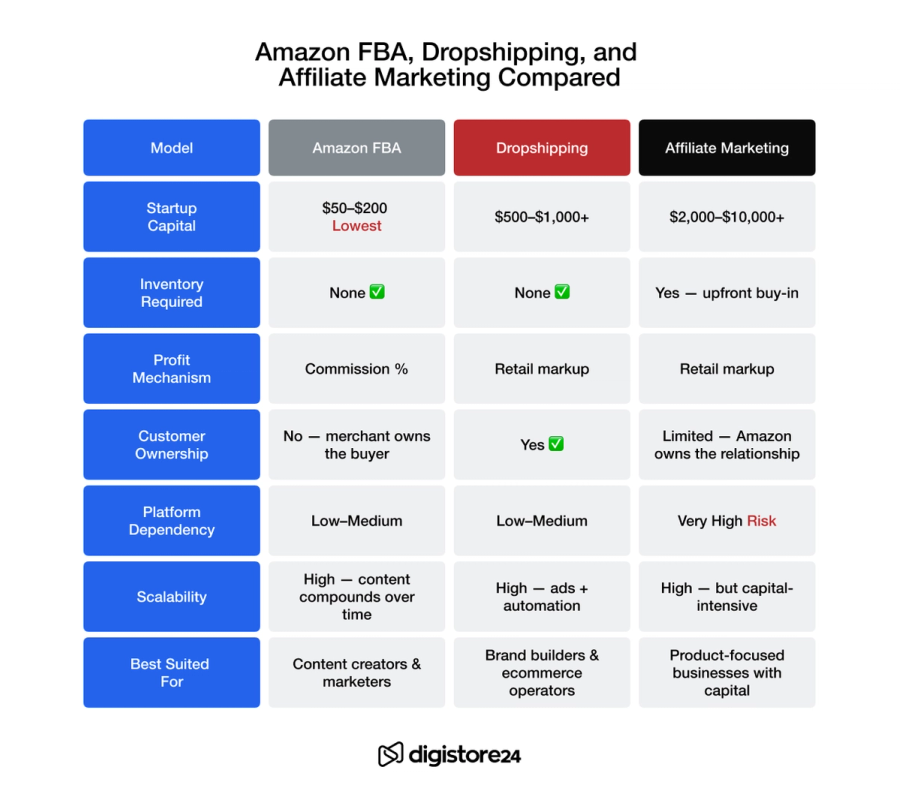
All three models can scale to significant revenue — the right fit depends on your starting capital, skills, and goals.
FBA's primary advantage is Amazon's built-in trust, search traffic, and logistics network. Its primary disadvantage is the upfront inventory investment, storage fees, and near-total dependence on Amazon's platform rules — a single policy change can strand thousands of pounds of stock in a warehouse.
Why Choose One? The Hybrid Model That Smart Operators Are Running
The most underexplored strategy in this space is not choosing between affiliate marketing and dropshipping — it is running both in a deliberate sequence or alongside each other. This hybrid approach is not a compromise; it is a compounding advantage.
Affiliate-First Niche Validation
Before committing the capital and time to build a dropshipping store, use affiliate content to validate whether a niche and its products have genuine demand. The logic is simple: if an audience clicks your affiliate link and buys a product at the merchant's standard price, they will buy it from your store too. Affiliate content — reviews, comparisons, "best of" articles — is cheap to produce and produces conversion data that no amount of market research can replicate.
The validation framework works like this:
- Identify a potential niche (fitness, home improvement, pet care)
- Create 10–15 pieces of affiliate content targeting buying-intent keywords
- Build an email list from that audience
- If affiliate conversion data is strong (>2% click-to-sale), the demand is proven
- Launch a dropshipping store selling the same category of products to your already-warm audience
This sequence eliminates the biggest risk in dropshipping — building a store around products nobody actually wants — before a single pound is spent on store setup or inventory sourcing.
Affiliate Links on a Dropshipping Blog
A dropshipping store's blog is an underutilised asset. Between purchase cycles, customers return to search engines for advice, comparisons, and recommendations. Content that serves this need — and includes affiliate links to complementary (non-competing) products — creates a second revenue stream with no additional customer acquisition cost.
Awin's research into media owner monetization found publishing houses that integrated affiliate links saw 53% growth in sales — the same principle applies to any content-rich ecommerce brand.
The broader strategic point: the two models share the same engine. The hybrid approach simply ensures that engine is never running at half capacity.
Platforms that sit at this intersection — where vendors list products, affiliates promote them, and the same creator can operate in both capacities — make the hybrid model especially accessible.
Digital vs. Traditional Dropshipping — A Line Worth Knowing
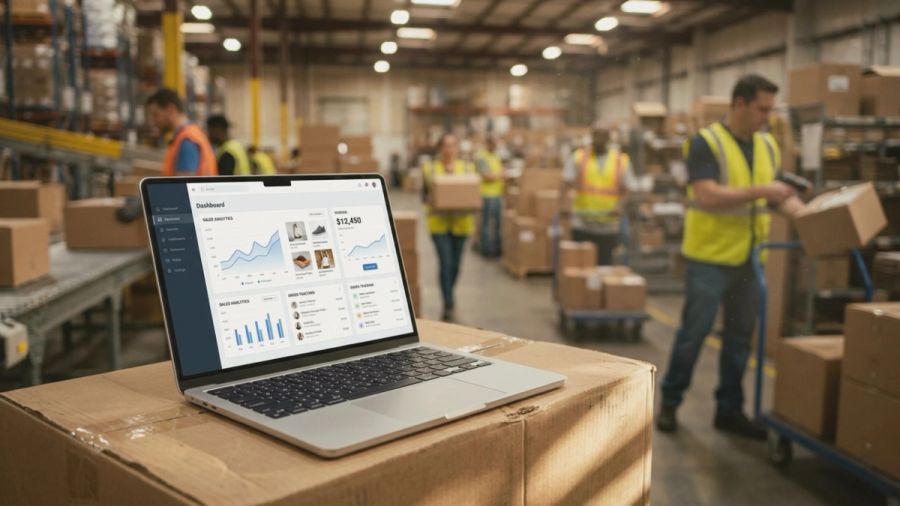
Traditional dropshipping involves physical goods: a customer orders, a supplier packs a box, a courier delivers it.
Digital dropshipping — sometimes called digital product selling — applies the same intermediary model to downloadable products: courses, ebooks, software licences, templates, and digital memberships. The key difference is that fulfilment is instant and free. The margin structure improves dramatically: without physical logistics costs, digital product sellers frequently retain 50–80% of each transaction.
Which Business Model Was Made for You?
The final bell has gone on the last round: both fighters are still standing. Neither model is the universal winner. Affiliate marketing is the lower-risk, lower-capital path that rewards patience, content quality, and audience-building — and compounds beautifully over time. Dropshipping is the higher-involvement, brand-building path that offers greater control, stronger exit value, and higher short-term income potential for operators willing to invest in advertising and store management.
In fact, it might be that the “hybrid” model is where the real leverage lives — using affiliate content to de-risk your niche before going all-in on a store, or using your dropshipping audience to compound affiliate revenue in the gaps between purchases.
The best business model is the one you actually start and bring to completion: with intention, preparation, focus and constant improvement.
Ready to explore affiliate marketing? Browse 8,500+ vetted offers across 44 niches — with transparent EPC and conversion data — on the Digistore24 marketplace.
Building a digital product business? Digistore24 acts as the merchant of record, handling payments, tax compliance, and automated affiliate recruitment — so you focus on the product, not the back office.
Still building your foundations? The Digistore24 Affiliate Marketing Academy is a free resource library covering everything affiliate. Check it out!
FAQ
Can you do affiliate marketing and dropshipping at the same time?
Yes — and for many operators, combining both is the smartest strategy. Affiliate content can validate a niche before a dropshipping store is built; a dropshipping blog can host affiliate links to generate passive revenue between purchase cycles. The skills required overlap almost entirely, and running both simultaneously diversifies income against the risk of either model underperforming.
Which is more profitable in 2026: affiliate marketing or dropshipping?
Dropshipping typically generates higher absolute monthly revenue for operators running paid traffic at scale — but net margins after advertising are a realistic 10–20%. Affiliate marketing offers lower absolute revenue in the early stages but improves significantly with experience. The profitable choice depends on available capital, risk tolerance, and whether you want to build a brand or a content-driven referral business.
How much money do you need to start affiliate marketing?
A functional affiliate site can be launched for as little as $50–$200 (domain, hosting, and basic content tools). Some affiliates even begin with zero spend using free social media platforms. Paid traffic strategies require more capital to test, but even then, initial test budgets of $200–$500 are sufficient to generate early conversion data.
What is the difference between digital and traditional dropshipping?
Traditional dropshipping sells physical goods shipped by a third-party supplier. Digital dropshipping sells downloadable or deliverable digital products — courses, software, ebooks — where fulfilment is instant and costs virtually nothing.


