

I remember the exact moment. I was sitting at my desk, phone in hand, heart pounding, about to say a number out loud that I had never said before in a business context.
"The investment for this coaching program is $20,000."
The person said no.
And honestly? That was the single most encouraging thing that ever happened to me when it came to high-ticket.
Because I said it. Out loud. To a real human being. And I didn't faint. I didn't die. The world kept spinning. And the next time I said that number, it was easier. And the time after that, it was just... a number.
That experience — co-founding and selling a high-ticket coaching program for bloggers over several years — completely changed how I think about affiliate marketing. Because here's what nobody tells you: selling a $20,000 product and selling a $47 ebook require astonishingly similar skills. The difference isn't in the sales technique. It's in the fit, the delivery, and the confidence.
Why High-Ticket Changes the Math (and Your Calendar)
For the brand or creator, high-ticket changes everything. When I was collecting income from dozens of small products — a $27 thing here, a $47 thing there — I was busy all the time but never felt like I could go deep on anything. High-ticket lets you clear the clutter. When a program is properly funded by its price point, the creator can justify spending real time, energy, and sometimes money on delivering an incredible experience.
They're not scrambling across fifteen small commitments. They're focused. And because the expectations are higher — as they should be at that price — they're motivated to build something genuinely excellent. The funding matches the ambition.
For you as an affiliate, the math works the same way. One $500 commission replaces fifty $10 commissions. Same effort to make the introduction. Wildly different outcome.
"Going away from cheap affiliate marketing to real brand-focused." — Luigi Florimo, Director of Affiliate Sales, Digistore24.
Customer Fit Is Everything (Especially at This Price)
For the brand, customer fit is non-negotiable. People will ask for refunds on a high-ticket product that doesn't deliver. And they should. If someone pays $2,000 or $5,000 or $20,000 for something and it's not the right fit, the brand is left with one of two outcomes — a disgruntled customer who feels ripped off (which eats away every ounce of credibility they've built) or feeling terrible about a client's lack of progress. Neither is worth it.
This is why high-ticket products are rarely sold without some form of deeper engagement — webinars, one-on-one calls, video conferences, longer-form content, or deeper funnels. That touchpoint is where the brand makes sure the product is the exact solution to this person's problem.
For you as an affiliate, this matters just as much. Your credibility is on the line with every recommendation. If you send someone into a $10,000 program and it's a bad fit, that person remembers who sent them there. So when you're evaluating high-ticket programs, ask yourself: can I honestly say this product will deliver results that justify the price? If yes, it's easy to recommend. If you're not sure, walk away. There are too many good programs out there to waste your reputation on something you can't stand behind.
What to Look for When Choosing a High-Ticket Program
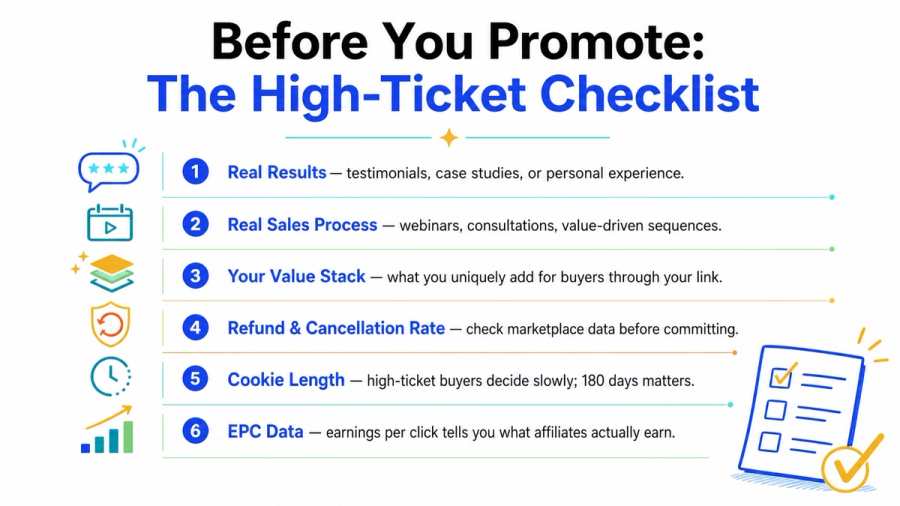
When I'm evaluating whether to promote a high-ticket product, I'm looking at a few things that go beyond commission rates:
Does the product actually deliver results? I need to see proof — testimonials, case studies, or ideally my own experience with it. The most common high-ticket affiliate fit is someone who was a student or coaching client, got results, and now wants to recommend it to others. That personal experience is powerful.
Is there a real sales process? High-ticket products that convert well almost always have deeper engagement in the funnel — webinars, consultations, longer-form content, value-driven sequences. If someone's trying to sell a $5,000 course with just a sales page and no support, that's a red flag.
What can you add to the value stack? This is where high-ticket affiliate marketing gets interesting. You're likely choosing a program within your niche or expertise. So think about what you — uniquely — could add. Maybe you offer coaching calls for people who sign up through your link. Maybe you have a relevant course, an audit service, a mastermind, or templates that complement the main program. When someone is about to spend $10,000 or $20,000, and you can add genuine value that they'd only get by going through you instead of another affiliate or even the program directly — that's a massive differentiator. There are likely other affiliates promoting the same high-ticket product. Your value stack is what makes your recommendation the obvious choice.
What's the refund and cancellation situation? On Digistore24's Marketplace, you can actually see cancellation rates before you promote a product. That's invaluable at the high-ticket level. A product with a 40% cancellation rate is telling you something about customer fit — or lack of it.
How long is the cookie duration? High-ticket buyers take longer to decide. A 24-hour cookie is useless here. Digistore24 offers an 180-day cookie duration, which actually respects the reality of how people make expensive purchasing decisions.
What's the EPC? Earnings Per Click tells you what other affiliates are actually making. It's not a guarantee, but it's real data. I'd rather make decisions based on marketplace data than guesswork.
The Sales Process Is Different (But Not How You Think)

Most people assume high-ticket means high-pressure. In my experience, it's the opposite.
High-ticket sales — whether you're the creator or the affiliate — are about finding the person for whom this product is a shortcut to their success. You're not convincing anyone. You're matching.
As an affiliate, your job is to introduce your audience to something you genuinely believe will change their situation. And you have more tools than just a link. You might host a webinar breaking down the program. You might create a comparison guide or a deep-dive review. You might build a funnel that educates and qualifies before sending people to the offer. The high-ticket price actually helps here — it filters for people who are serious, committed, and ready to do the work.
And this is where your value stack comes back into play. When you're promoting through webinars or deeper content, you can naturally introduce the bonuses you're adding. "If you join through my link, you also get X, Y, and Z." That's not sleazy. That's genuinely making the offer better for your audience.
"Has thousands of past customers that still buy from her even though she's not 'in' it actively anymore." — Lenée Gill, Head of Sales, Digistore24.
That's what high-ticket builds. Not transactions — relationships that compound over time.
Where to Find High-Ticket Programs Worth Promoting
You have a few options:
Affiliate marketplaces give you data and infrastructure. On Digistore24, you can browse 44+ niches, see EPC and conversion rates, check cancellation data, and request to promote products — many without needing approval at all. The Marketplace handles payment processing, tracking, tax compliance, and payouts (up to three times per week). For high-ticket specifically, the 180-day cookie and lifetime commissions mean you're building long-term revenue, not just chasing one-time sales.
Direct brand relationships can offer higher commissions or exclusive terms, but you're doing more due diligence yourself. There's no public EPC data. You're relying on what the vendor tells you and your own testing.
Your own network is often the best source. When you've been in the space long enough, you know who's delivering real results. Those personal referrals — "I know this person, I've seen their students succeed" — carry more weight than any sales page.
If you're building your own high-ticket product and want affiliates to promote it, tools like Pagewheel can help you create the digital assets and funnels that support a high-ticket launch, and you can push products directly into Digistore24's Marketplace where affiliates can find you.
Price Justification: It's About the Shortcut
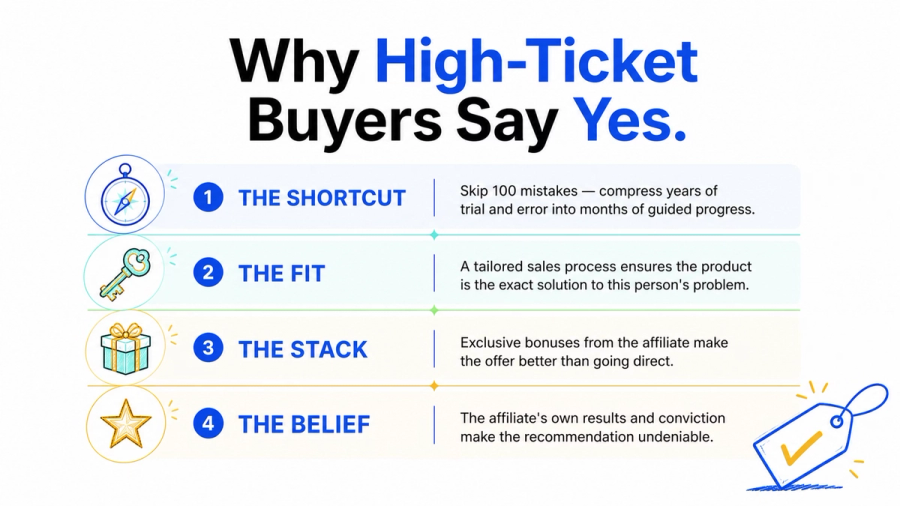
The last thing I'll say is this: the sticker price doesn't matter as much as you think.
High-ticket pricing isn't just about what someone will earn back. It's about what they'd pay to skip the painful part. I've said many times that I would pay a million dollars to have skipped certain three-year stretches of my career — the mistakes, the dead ends, the things I had to learn the hard way. A good high-ticket program can help someone skip 100 mistakes, bypass 30 steps, and compress years of trial and error into months of guided progress.
That's the real price justification. Not "you'll make your money back" (though that matters too), but "what would you pay to not have to figure this out alone?"
When I said "$20,000" on that first call and the person said no, I wasn't crushed. I was relieved. Because I knew the program was worth it. I knew the next person who said yes would get results that justified the investment many times over. And they did.
That's the foundation of high-ticket affiliate marketing. Not tactics. Not funnels. Not commission rates. Belief in what you're recommending, backed by evidence that it works — and the knowledge that you're offering someone a shortcut they'd gladly pay for.
Find products you believe in. Make sure the customer fit is right. Add your own value where you can. And don't be afraid to say the number.
FAQ
What is high-ticket affiliate marketing?
High-ticket affiliate marketing means promoting products or services that pay a high commission per sale — typically $100 or more, often $500 to $2,000+. These are usually courses, coaching programs, software, or high-end services.
Is high-ticket affiliate marketing legit?
Absolutely. It's the same model as any affiliate marketing — you earn a commission for referring a customer. The difference is the product price point and usually the level of trust required to make the recommendation.
How do I find high-ticket affiliate products?
Start with affiliate marketplaces like Digistore24 where you can see real performance data (EPC, conversion rates, cancellation rates). Look for products in niches you understand with price points that justify the commission structure.
Do I need a big audience for high-ticket?
Not necessarily. Because you need fewer sales to hit your income goals, a smaller but highly engaged audience can work well. What matters more is trust and relevance — does your audience have the problem this product solves, and do they trust your recommendation?
What's a good commission rate for high-ticket products?
Digital products and courses often offer 30–50% commissions. On a $1,000 product at 40%, that's $400 per sale. Look for programs with recurring commissions or lifetime cookies to maximize long-term earnings.


